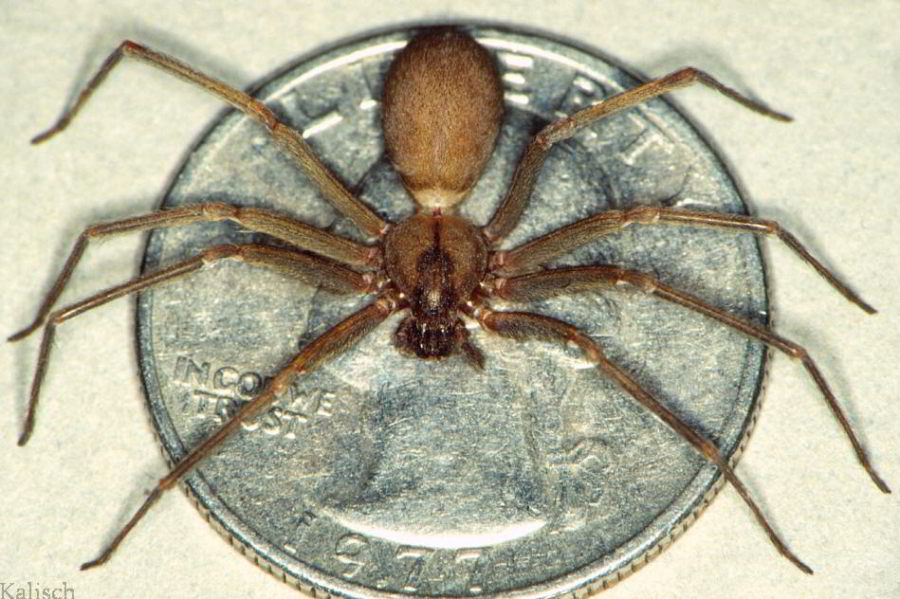
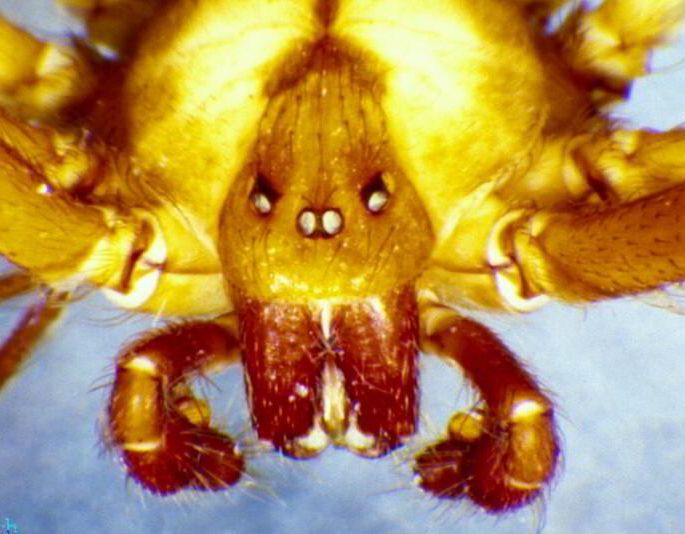
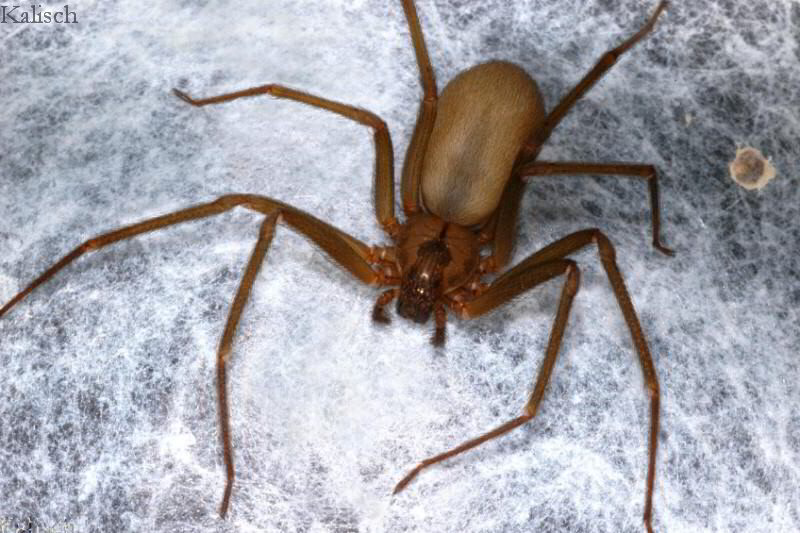
Running Crab Spider (Family Philodromidae)
|
Jumping spiders (Family Salticidae) get their name from the sometimes spectacular leaps they make when pouncing on prey or simply hopping about in the foliage. They are very small to medium sized spiders 3-15mm (1/8 -- 5/8") long. Their eight eyes are arranged in 3 rows - the first row near the midline contains the largest pair, which faces forward in the manner of predatory animals requiring binocular vision, and a second, smaller pair outboard of those, also facing forward and slightly upward. The second row of eyes is very mach smaller and facing upwards and only slightly forward. Our page on the bold jumping spider, Phidippus audax has many pictures showing the jumping spider's eye arrangement. The jumping spiders have the most acute eyesight of all spiders. Salticids do not build webs to snare prey, they only spin small silken retreat webs under leaves, bark or twigs. Our page on the Phidippus princeps species shows a spider in one of these webs. When hunting, jumpers always trail a silken strand from their spinnerets. If they are disturbed, they will rapidly descend on this lifeline to the ground and out of sight, or if they miss their jump, they can climb the thread back to their previous perch. These little guys are very adept at hiding, and if they do not want you to see them, you won't. They always watch me very carefully when I'm photographing them, and almost always face me, which accounts for all the similar poses you'll see on our pages. You can find an extensive write-up on the family salticidae at The Tree of Life Website |
 Bold Jumping spider Phidippus audax |
 Coy Jumping Spider Phidippus princeps |
 Magnolia Green Jumper Lyssomanes viridis |

Jumping Spider
Phidippus otiosus |
 Phidippus clarus |
 Phidippus princeps |

Hentzia palmarum |

Thiodina sylvana |
 All thumbnails pages |

Zebra Jumper
Salticus scenicus |

Dimorphic Jumper
Maevia inclemens |
 Jumping Spider Phidippus mystaceus |
|

I love the comb-like rows of hairs on this lovely
spider's rear leg tibiae. Leucauge venusta
Stabilimenta are conspicuous lines or spirals of silk, included by many diurnal spiders at the center of their otherwise cryptic webs. It has been shown spider webs using stabilimenta catch, on average, 34% fewer insects than those without. However, webs with the easily-visible markings are damaged far less frequently by birds flying through the web. It is an evolutionary tradeoff the spider can influence every time it builds a new web. The inclusion of stabilimenta is influenced by many factors, including prey density and web location. Read the scientific study at Behavioral Ecology magazine. In any event, stabilimenta or no, a large Argiope planted firmly head-down in her web amongst tall weeds and grasses remains maddeningly invisible to man and beast. The black and yellow markings of the fat abdomen and striped legs function as camouflage much like the tigers' stripes do in the jungle - the geometric elements serve to break up the outline of the spiders' body and confuse the eye of the beholder into not recognizing the image. It is this principle upon which warships' hull camouflage was painted during the World Wars, with stark diagonal lines and shapes intended to keep an enemy from discerning the outline and identifying the size of the ship and the extent of its armaments.
I find watching the orb weavers fascinating; whether they are spinning or attacking prey or even just sitting, they provide just the right amount of dread and horror and creepiness. I think I like them so much more than other spiders because they are generally out there where I can see them, not hiding in my shoe. I love the grisly spectacle of a huge Argiope attacking a wasp or grasshopper (and I confess to throwing not a few unfortunates into their clutches during photographic down time) and marvel at the evolutionary processes that resulted in these beautiful creatures and their stunningly efficient predatory style. |
 Female funnel web weaver |
 Funnel web weaver |
 Spider at funnel retreat |
 Agelenopsis on sheet web | Funnel web weavers (Family Agelenidae) are small to medium sized spiders often found in grassy fields,
low shrubbery, or living among leaf litter in forests.
They spin sheet webs of nonsticky silk with a characteristic
funnel extending off to one side. The funnel is where the
spider hides while awaiting prey. There is a 3-dimensional
barrier web spun above the sheet web, and when a prey item
falls through onto the sheet web, the spider quickly runs
out and bites its victim, then drags it back to the funnel
to feed. These sheet webs are nearly invisible unless
covered with dewdrops on a cool morning, and the spider can
move very quickly over the surface. It almost looks as if
the spider is walking on air. There are over 400 North
American species.
Spiders in the most common genus,
Agelenopsis, are commonly called "grass spiders," after
their habit of building their combination sheet-and-funnel
webs in grass and low shrubs. | |

Wolf Spider in the family
Lycosidae. Wolf spiders are active hunters that do
not rely on webs to trap prey. |
 Wolf Spider - Shizocosa sp. |
 Camouflage invisibility |
 Wolf spider female |
 Wolf spider momma |
Wolf Spiders (Family Lycosidae) are ground hunters. Except for one genus, they spin no webs at all; some dig burrows in the ground or under rocks, many have no retreat at all. They have eight eyes of unequal size arranged in three rows, the first row having four eyes. The long thin legs have three microscopic claws at their tips. The female spins a large spherical egg sac, attaches it to her spinnerets and drags it around until the eggs hatch. The hatchlings then climb onto her back and stay there until they are able to fend for themselves. I accidentally touched the momma spider in the pictures above - the dozens of spiderlings instantly scattered and were all gone within seconds.

Nursery Web Spider in the family
Pisauridae, with
egg sac |
Nursery Web Spiders (Family Pisauridae)
superficially resemble wolf spiders. Most spiders in this family (which includes the so-called fishing spiders) have their eyes arranged in two rows, with the front row in a straight line of four, the second row curved in a u-shape. These spiders do not build webs to catch prey, but use silk to construct a special nest or nursery web. The female carries a spherical egg sac around until the eggs are ready to hatch, then constructs a web and places the egg sac inside. She then stands guard nearby until the spiderlings have all grown and dispersed. Some of the largest spiders in this family, the fishing spiders, run over the surface of ponds and streams, and sometimes even go underwater. They may capture tadpoles and small fishes near the surface, but mostly prey on insects.
|
Cobweb spiders (Family Theridiidae) are also called comb-footed spiders, after the inconspicuous comb like bristles on the hind tarsi of many species. These spiders spin irregular webs (cobwebs) and use their combs to fling silk over any prey that gets caught in the web. The thus swathed victim is then hauled to a rest site, injected with venom, and later eaten. There are more than 200 North American species in this family, including the black widow spider, Latrodectus mactans. |

Steatoda triangulosa |

Theridion sp. |
|
Crab spiders (family Thomisidae) hold their legs outstretched to the sides, in the manner of their crustacean namesake, and can move forwards, sideways, or backward. They have short, broad bodies and 8 small eyes sometimes located on raised bumps. The second pair of legs is often much heavier and longer than the third and fourth pairs. Crab spiders do not build any sort of web, they prowl the ground and climb flowers and plants in search of prey. Many are masters of camouflage and simply await their prey on flowers, much like ambush bugs. |
|