Silkworm Thorn - Cudrania tricuspidata
Mulberry Family: Moraceae
This Chinese native is commonly called Che, Chinese Mulberry, Cudrang, Mandarin Melon Berry, and storehousebush. [1] [2]
[Cirrus Home]  [Tree Encyclopedia]
 

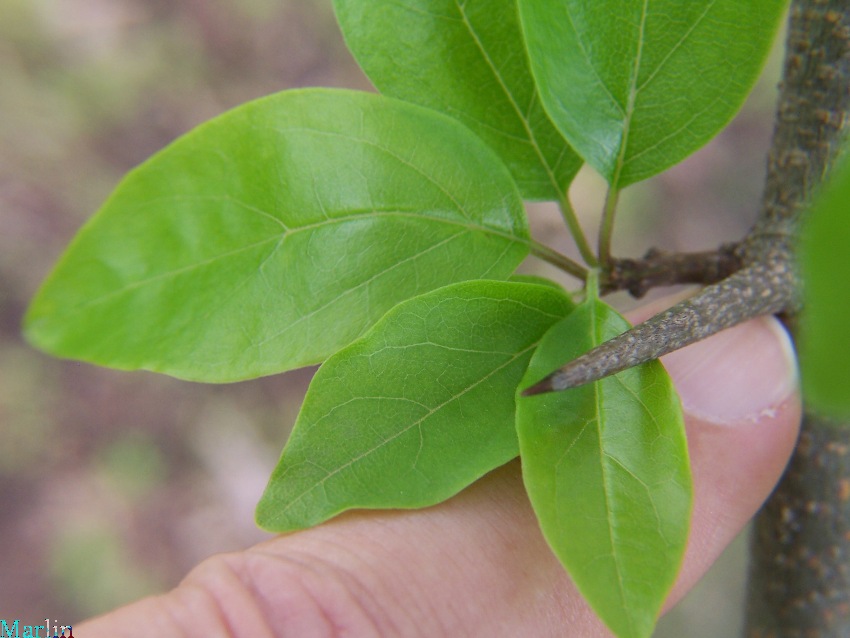
Silkworm Thorn Tree thorns and foliage
Foliage and eponymous thorn. Silkworm larvae will eat these leaves.

A deciduous tree reaching 25 feet, the silkworm thorn is native to many parts of eastern Asia from the Shantung and Kiangson Provinces of China to the Nepalese sub-Himalayas. It became naturalized in Japan many years ago. In China, the leaves of the che serve as a backup food for silkworms when mulberry leaves are in short supply. The tree was introduced into England and other parts of Europe around 1872, and into the U.S. around 1930. [2]

Like the closely related Mulberry, the silkworm thorn fruit is not a true berry, but a collective. Much larger than mulberries, the Che fruit can be up to 2 inches in diameter. The ripe fruits are deep red, containing juicy flesh and small brown seeds. Nearly tasteless when young, they can develop into a delicious, sugary fruit. Sold locally in markets in China and elsewhere in east Asia, the fruit attracts little commercial interest elsewhere. The fruit can stain roofs, driveways or sidewalks, hence the tree should be placed in and isolated location in full sun. [2]

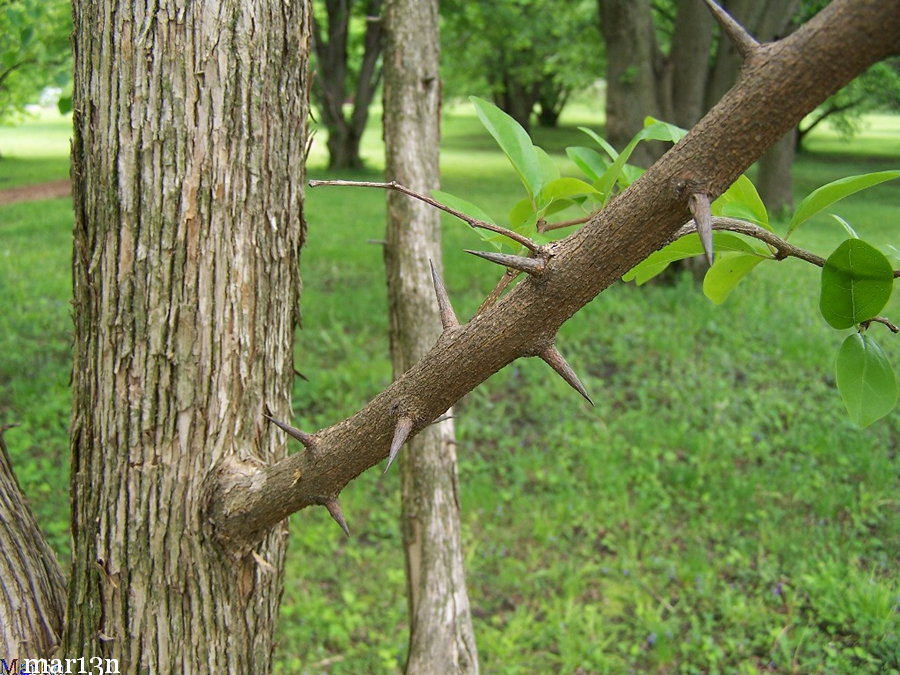
Silkworm Thorn Tree thorns
Bark and thorns are reminiscent of the very closely related Osage Orange, Maclura pomifera.

ITIS Taxonomic Hierarchy [1]

KingdomPlantae  -- Planta, plantes, plants, Vegetal 
    SubkingdomTracheobionta  -- vascular plants
       DivisionMagnoliophyta  -- angiospermes, angiosperms, flowering plants, phanérogames, plantes à fleurs, plantes à fruits
          ClassMagnoliopsida  -- dicots, dicotylédones, dicotyledons
             SubclassHamamelidae 
                OrderUrticales 
                   FamilyMoraceae  -- mulberries
                      GenusCudrania Trécul -- cudrania
                         SpeciesCudrania tricuspidata (Carr.) Bureau ex Lavallée -- storehousebush


Shrubs or small trees, 1-7 m tall, deciduous. Bark grayish brown. Branchlets slightly ridged, glabrous; spines 0.5-2 cm. Winter buds reddish brown. Petiole 1-2 cm, sparsely pubescent; leaf blade ovate to rhombic-ovate, occasionally 3-lobed, 5-14 × 3-6 cm, abaxially greenish white and glabrous or sparsely pubescent, adaxially deep green and glabrous, base rounded to cuneate, margin entire, apex acuminate; secondary veins 4-6 on each side of midvein, tertiary veins reticulate. Inflorescences axillary, single or in pairs. Male inflorescences capitulate, ca. 5 mm in diam.; peduncle shorter than capitulum. Female inflorescences 1-1.5 cm in diam., axillary; peduncle short. Male flowers: calyx lobes fleshy, margin revolute, apex thick; pistillode pyramidal. Female flowers: calyx lobes with margin revolute, apically shield-shaped; ovary immersed in lower part of calyx. Fruiting syncarp orange red when mature, ± globose, ca. 2.5 cm in diam. Fl. May-Jun, fr. Jun-Jul.

Sunny forest margins, mountain slopes; 500-2200 m. Anhui, Fujian, SE Gansu, Guangdong, Guangxi, Guizhou, Hebei, Henan, Hubei, Hunan, Jiangsu, Jiangxi, Shaanxi, Shandong, S Shanxi, Sichuan, Yunnan, Zhejiang [Japan (cultivated), Korea].

The bark fibers are used for making paper, the leaves are used as food for silkworms, the fruit are edible, and the bark is used medicinally. [3]


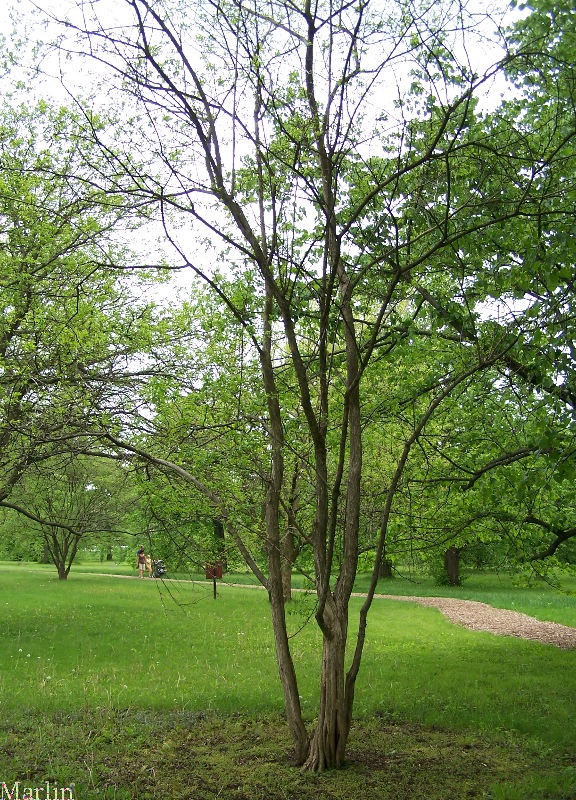
Silkworm Thorn - Cudrania tricuspidata
This Silkworm Thorn at the Morton Arboretum in northern Illinois was started from seed 28 years ago.

Silkworm Thorn Bark
Bark, braches, twigs and Morton Arboretum accession tag

References
  1. ITIS Standard Report, Cudrania tricuspidata  (Carr.) Bureau ex Lavallée.
  2. California Rare Fruit Growers Inc., CHE
  3. Flora of China, Maclura tricuspidata


       web      www.cirrusimage.com
[Cirrus Home]  [Tree Encyclopedia]
© Red Planet Inc.