|
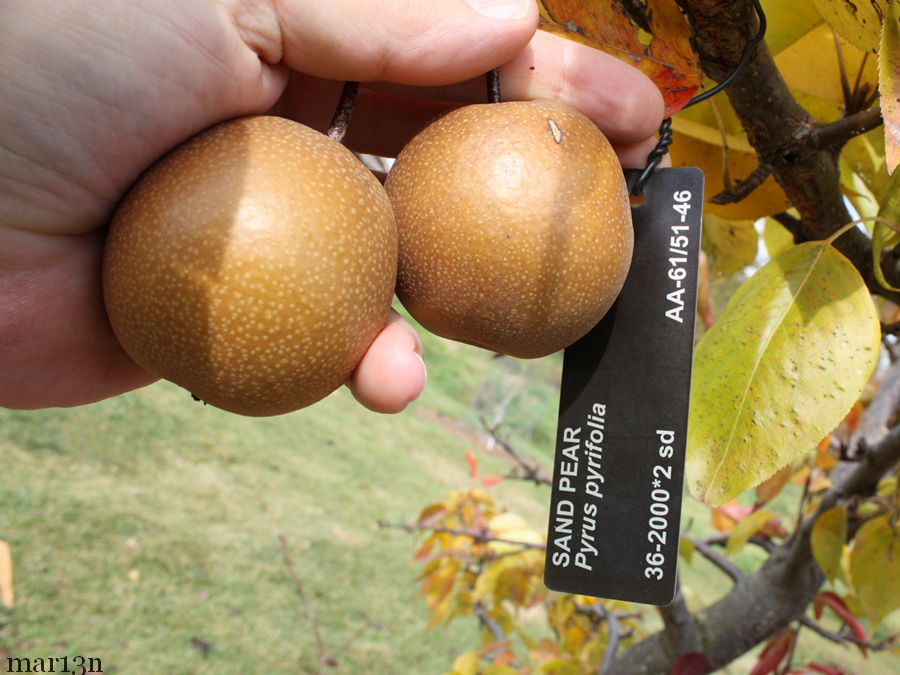
Sand pear is native to China,
Laos and Viet Nam, and is cultivated elsewhere in
Asia, naturalized in Japan. [1] It is listed present
in 4 United States: Illinois, Maryland, West
Virginia, and Virginia. [2]
In Japan, nashi pears are
harvested in Chiba, Ibaraki, Tottori, Fukushima,
Tochigi, Nagano, Niigata, Saitama and other
prefectures, except Okinawa. Nashi may be used as an
autumn kigo, or "season word", in writing haiku.
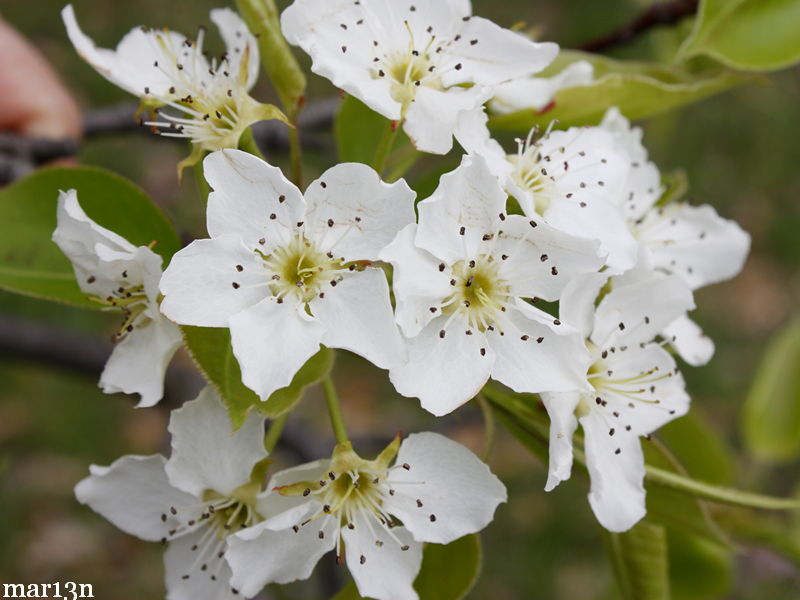
Nashi no hana (pear flower) is also used as a kigo
of spring.
In China, they have been considered a popular and
sacred fruit. Many popular sayings have come from
them. In Korea, they are grown and consumed in great
quantity. Many are exported to the U.S. and sold as
gifts, touting the superior quality of pears grown
on the peninsula versus those grown in Southern
California. Imported pears tend to be quite large
and very fragrant, and are carefully wrapped,
allowing them to last several weeks or more in a
cold, dry place.[citation needed] In the South
Korean city of Naju, there is a museum called The
Naju Pear Museum and Pear Orchard for Tourists.
Because of their relatively high price and the large
size of the fruit of cultivars, the pears tend to be
served to guests or given as gifts, or eaten
together in a family setting. In cooking, ground
pears are used in vinegar or soy sauce-based sauces
as a sweetener, instead of sugar. They are also used
when marinating meat, especially beef. In Taiwan,
nashi pears harvested in Japan given as luxurious
presents. In Australia, nashi have been produced
commercially for more than 25 years.
[Wiki cite]
Over 1,000 cultivars of common
pear, P. communis, are known, and it is
itself believed to be a hybrid originating in
western Asia over 2,000 years ago. Common pear is
naturalized throughout Europe and has been grown for
its fruit for centuries. Many named cultivars were
raised at Versailles, France, during the 17th
century.
[3]
Pear has fine-grained wood pink to yellow in tone.
It is prized for woodwind instruments and its veneer
is used for fine furniture. Pear has one of the
finest of textures of the fruitwoods, and was often
used in making instruments such as lutes, recorders
and - because of its hardness - the jacks of
harpsichords.
|