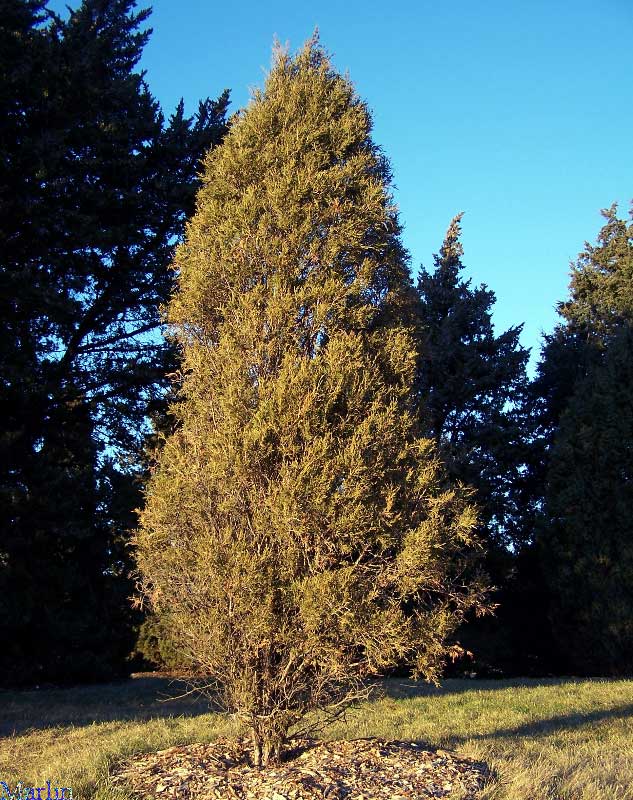
Rocky Mountain juniper is a
perennial, evergreen gymnosperm native to North
America. The species grows as a shrub or tree to
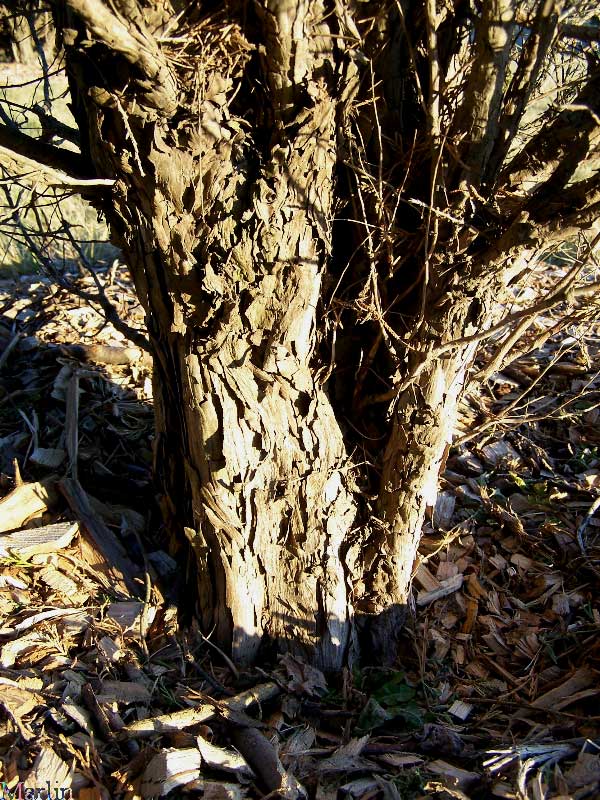
30 feet (10 m) or more and has thin, fibrous
bark that usually shreds with age. In the open,
trees are stubby and broadly pyramidal with
branches to ground level. In shaded areas, the
trunk is less tapered and foliage arranges in
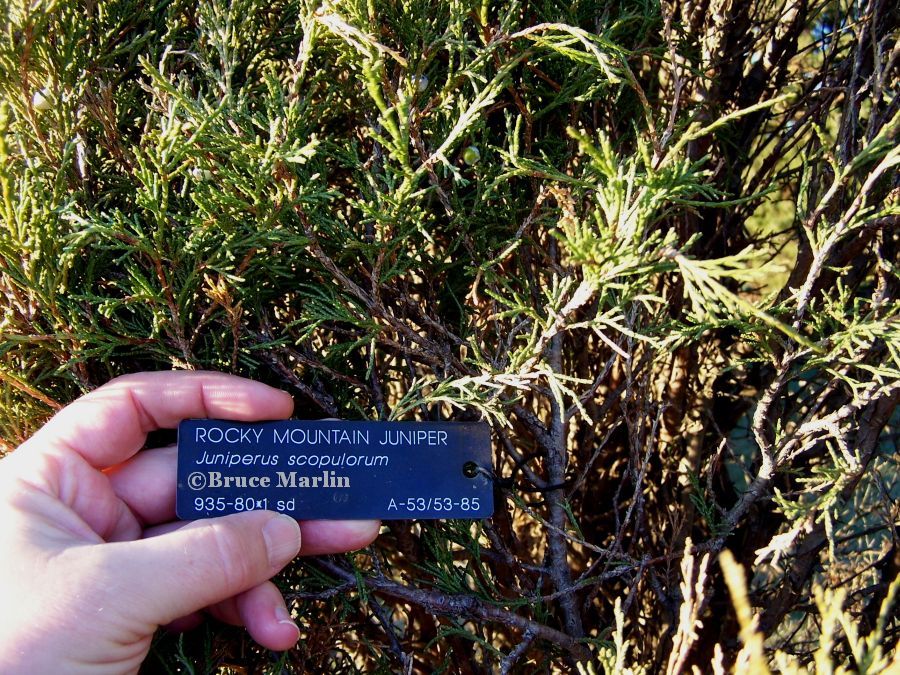
"weeping sprays". Leaves are scalelike and
0.03-0.11 inch (1-3 mm) long or needlelike and
0.11-0.47 inch (3-12 mm) long.
Rocky Mountain juniper prefers calcareous and
somewhat alkaline soils and grows best on moist,
deep soils. It survives extremes of temperature
well. Rocky Mountain juniper is considered hardy
except for "burning" of foliage on trees exposed
to northwest winds during winter in the northern
Great Plains. It can tolerate shade when young,
but becomes intolerant later in life. It is more
drought tolerant than eastern redcedar and less
so than other tree junipers in the west. In
fact, during the 1930s drought, Rocky Mountain
juniper woodland maintained and expanded range
in the western Dakotas.
Rocky Mountain juniper occurs throughout the
drier mountains and foothills of British
Columbia and Alberta; south through the Great
Basin and Rocky Mountains to Arizona, New
Mexico, and western Texas; and north across
eastern Colorado, western Nebraska and North
Dakota, Montana, and into Saskatchewan. It is
also found on Vancouver and other Puget Sound
islands, as well as the surrounding mainland.
Rocky Mountain juniper is found over most of the
range of pinyon (Pinus spp.)-juniper (Juniperus
spp.) woodlands. It is a major tree species in
the higher elevations of pinyon-juniper
woodlands in Colorado, northern New Mexico, and
Arizona, and locally in Nevada and Utah. In
pinyon-juniper woodlands, it is found in
association with other juniper species such as
alligator juniper, oneseed juniper, and Utah
juniper, as well as Colorado pinyon (Pinus
edulis), Mexican pinyon (P. cembroides), and
singleleaf pinyon (P. monophylla).
Rocky Mountain juniper communities in the
northern Great Plains are often restricted to
steep, north-facing slopes. Individuals may be
scattered across other areas in mountains and
canyons throughout the Rocky Mountain region,
such as rocky outcrops, butte tops, draws, and
floodplains [19,49,58,109]. Rocky Mountain
juniper forms open woodland with sagebrush and
grasses, and it is often found mixed with
Douglas-fir (Pseudotsuga menziesii), Gambel oak
(Quercus gambelii), or ponderosa pine (Pinus
ponderosa). It is also found along waterways in
pure stands or as understory in the cottonwood
(Populus spp.)-willow (Salix spp.) habitat type.
It forms pure stands at middle and low
elevations in the northern part of its range.
|

Rocky Mountain juniper is
most abundant in dry, clay, rocky, or sandy
slopes, canyons and wash areas as well as
prairie hillsides, fields, pastures, and
woodlands. The species grows best along ravines,
in canyon bottoms, and on moist, cool hillsides.
It is found on exposed bluffs, rocky points, and
southern exposures throughout its range and is
common on northern exposures in North Dakota and
South Dakota.
Rocky Mountain juniper is important forage and
cover to many wildlife species. Waxwings are the
principal consumers of Rocky Mountain juniper
cones ("berries"), but numerous other birds and
mammals include the berries in their diets. Big
sagebrush (Artemisia tridentata), bitterbrush
(Purshia spp.), and Rocky Mountain juniper
combined have been reported to make up 66% of
winter mule deer browse and Rocky Mountain
juniper is considered a major component of
wintering mule deer diet in the Bridger
Mountains of Montana. Mule deer browse the
foliage moderately in winter, spring, and fall,
and lightly in the summer. High levels of
volatile oils in Rocky Mountain juniper may
cause mule deer to select against the foliage in
favor of other browse when available. Other
animals that use Rocky Mountain juniper berries,
foliage, or stems for forage include
white-tailed deer, black-tailed deer, Rocky
Mountain goats, ring-necked pheasant, grouse,
and cattle. Overall, it is rated good in energy
value and fair in protein value.
Rocky Mountain juniper woodlands provide nesting
habitat, migratory corridors, and winter food
and cover for birds otherwise found only in
forested areas and provide needed woody cover
for birds on the edges of grasslands. Rocky
Mountain juniper is a favored nesting tree of
chipping sparrows, robins, song sparrows, and
mockingbirds, and is used for nesting by
sharp-shinned hawks in Utah. Juncos, myrtle
warblers, sparrows and other birds roost in the
dense foliage. In the northern Great Plains
Rocky Mountain juniper woodlands provide habitat
for bushy-tailed woodrats, white-footed mice,
deer mice, prairie voles, pocket mice, and
eastern cottontail. Big game use the Rocky
Mountain juniper habitat type for forage and
cover.
Rocky Mountain juniper is occasionally used for
erosion control, and the tree has been used for
revegetating mine spoils in Kansas. Its dense
branches, cold hardiness, drought tolerance, and
relative freedom from pests make it a desirable
choice for windbreaks and ornamental plantings;
it is the most widely planted conifer species
for protective plantings in the Great Plains.
OTHER USES:
Rocky Mountain juniper's close-grained, durable,
aromatic wood is used for furniture, interior
paneling, fence posts, fuel, and novelties such
as chests. It is especially well-suited for
fencing because the wood lasts a long time in
contact with the ground. The wood is not used
regularly for other products due to its small
size and knotty, twisted trunks. Northern Plains
tribes preferred Rocky Mountain juniper branches
for making bow staves.
Native Americans have used Rocky Mountain
juniper seeds, "berries", and foliage for
incense, teas, or salves to treat a variety of
ailments including respiratory problems,
backaches, vomiting and diarrhea, dandruff, high
fever, arthritis and muscular aches, kidney and
urinary ailments, and heart and circulatory
problems. It has also been used to facilitate
childbirth. Juniper berries are also used in gin
making. (1) |
|