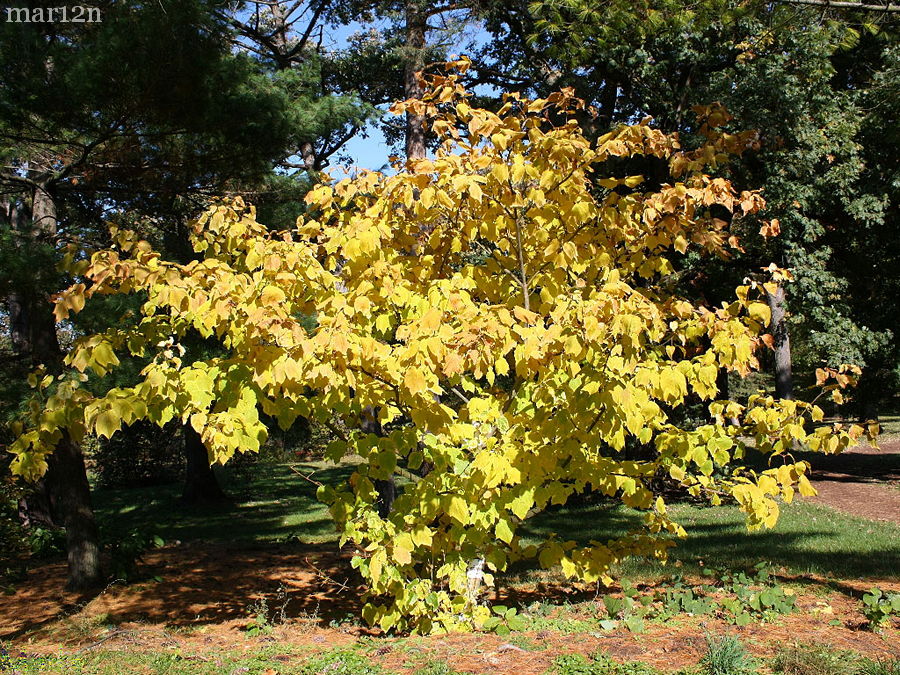
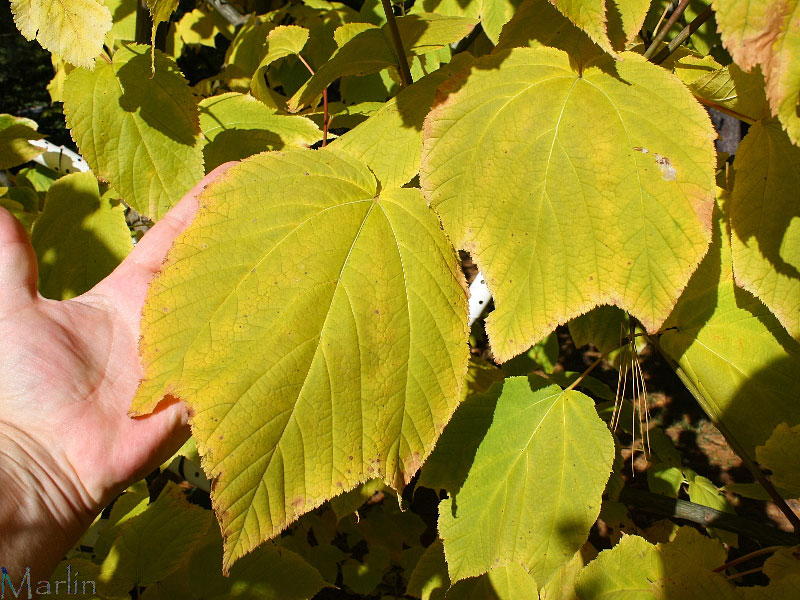
Striped Maple - Acer pensylvanicum [1]
Native to North America, Striped Maple is listed by Ohio as endangered, and by Rhode Island as "special concern." [2]
Common names include goosefoot, moosewood, snakebark maple, and pennsylvanischer Ahorn or Streifenahorn (German). [3]
Tree Encyclopedia Graphics | Trees Table of Contents | Family Aceraceae Main Page Graphics

Striped Maple Leaves

Striped maple is a small tree or large shrub identified by its conspicuous vertical white stripes on greenish-brown bark. It grows best on shaded, cool northern slopes of upland valleys where it is common on welldrained sandy loams in small forest openings or as an understory tree in mixed hardwoods. This very slow growing maple may live to be 100 and is probably most important as a browse plant for wildlife, although the tree is sometimes planted as an ornamental in heavily shaded areas.

Native Range
Striped maple is widely distributed over the northeastern quarter of the United States and southeastern Canada. Its natural range extends from Nova Scotia and the Gaspe' Peninsula of Quebec, west to southern Ontario, Michigan, and eastern Minnesota; south to northeastern Ohio, Pennsylvania, and New Jersey, and in the mountains to northern Georgia. The species is distinct from other maples, and there is no evidence of intergrading with other species. [4]

  • NORTHERN AMERICA
    Eastern Canada: Canada - Nova Scotia, Ontario [s.], Quebec [s.]
    Northeastern U.S.A.: United States - Connecticut, Maine, Massachusetts, Michigan, New Hampshire, New Jersey, New York, Ohio [n.e.], Pennsylvania, Rhode Island, Vermont, West Virginia
    North-Central U.S.A.: United States - Minnesota [e.], Wisconsin
    Southeastern U.S.A.: United States - Georgia [n.], Kentucky [e.], Maryland [w.], North Carolina [w.], South Carolina, Tennessee, Virginia [3]

Striped Maple Tree
Striped Maple in fall colors

Striped maple produces a crop of flowers each year, under either arboretum or natural conditions. Blooming occurs in May and June and begins after the leaves are nearly mature. Flowers are usually pseudohermaphroditic, yellow, and about 6 mm (0.25 in) in diameter, occurring in pendulous racemes that range from 10 to 15 cm (4 to 6 in) in length.

Functional male flowers have a rudimentary pistil that may occasionally be absent; functional female flowers develop stamens but the pollen sacs do not dehisce. A few flowers have been found that appear to be functionally perfect. Flowering may occur among trees as young as 11 years old and as small as 1 m (3.3 ft) in height (13,15).

Fruits of striped maple are samaras borne on pedicels ranging from 10 to 15 mm (0.4 to 0.6 in) in length. Their color is somewhat reddish in early development, changing later to tan. Wings are widely divergent with nutlets about 20 mm (0.8 in) long. [4]

References

  1. Striped Maple - Acer pensylvanicum, Morton Arboretum acc. 157-97*1, photographed October 19, 2009 by Bruce Marlin

  2. USDA NRCS Plants Database, "Acer pensylvanicum L. striped maple"
  3. USDA GRIN, "Taxon: Acer pensylvanicum L."
  4. William J. Gabriel and Russell S. Walters, USDA Forest Service, Northeastern Area, "Striped Maple"


Custom Search


Tree Encyclopedia Graphics | Trees Table of Contents | Family Aceraceae Main Page Graphics

© Red Planet Inc.