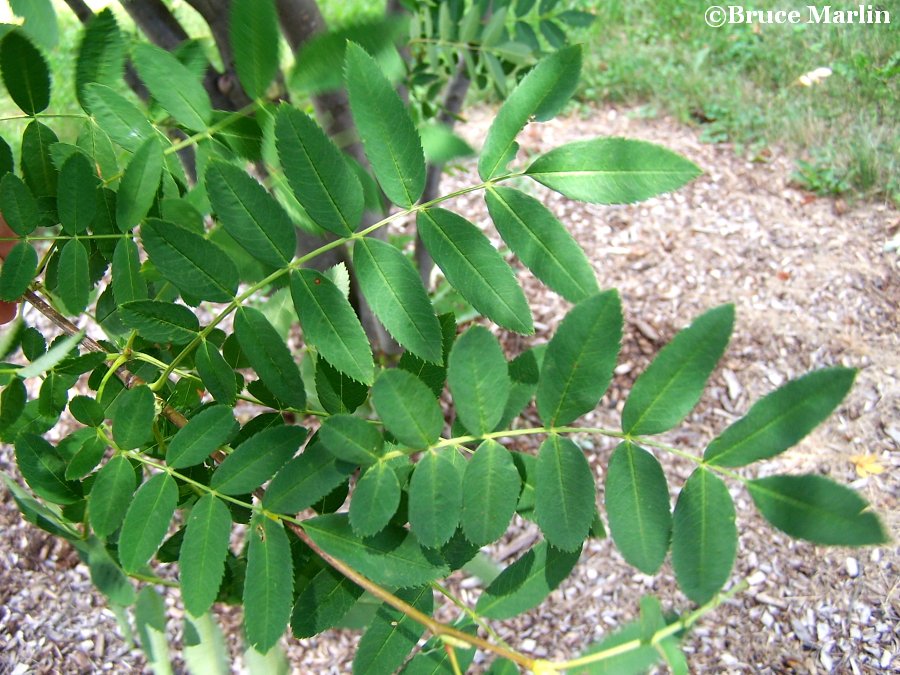
Hupeh Mountain-ash - Sorbus hupehensis
Native to China and Korea, this compact tree with delicate, fern-like foliage makes an ideal ornamental for gardens and specimen plantings. Unlike most mountain ashes, this tree's berries are often white.
[Rosaceae Graphics]  [Tree Encyclopedia] [Trees Alphabetic Table of Contents]   [Family Rosaceae Table of Contents]


Hupeh Mountain-ash

The Sorbus genus covers about 190 different species of deciduous trees and shrubs, found mainly in northern temperate regions, in woodland, on hills, mountains and on scree. Sorbus species and cultivars are prized for their ornamental qualities. Their leaves are decorative, and may be either simple or pinnate, and often color well in autumn. Their flowers are a second plus point. They grow as terminal corymbs of small, white or rarely pink flowers in spring and early summer. These are followed by round or oval berries that may be white, yellow, orange, red or brown.

There are two types of Sorbus. The first belong to Section Aria and include the whitebeams. They have simple leaves that often have serrated margins and are sometimes lobed. The leaves are ordinarily white or silvery beneath giving them a shimmering look when blown by the breeze. In the autumn, their clusters of brown to red fruits are attractive and their foliage turns vivid colors. S. intermedia (Swedish whitebeam) is a small to medium-sized tree with a dense, rounded head of branches. The deeply lobed, shiny dark green leaves are clothed in white down on the underside. In the spring, compact heads of white flowers are produced; these are followed by bunches of reddish-orange berries. S. vestita (Himalayan whitebeam) is an attractive, medium-sized tree with large green leaves with a silvery-white or buff color beneath. The green fruits are tinged and speckled with brown. S. alnifolia (Korean mountain ash) grows 12-15m (40-50 ft) high. Its crown is cone-shaped when young, eventually becoming rounded. In the spring, it bears white blossoms that are followed by clusters of bright orange to red berries.

The plants of the second type belong to Section Aucuparia and include mountain ashes. Sorbus hupehensis belongs in this section. These plants have pinnate leaves, giving them a fern-like appearance; the foliage turns shades of red and yellow in autumn. In the spring, they produce clusters of cream-colored flowers, which are followed by bunches of attractive berries that are usually brilliant red, but may be white, pink, orange, or yellow. (1)

The showy white flowers appear in early summer, and the abundant orange fruit appear in summer, persisting through winter. Fruit provides palatable browse for many animals and birds, but is not suitable for human consumption, except, perhaps for various folk remedies; the plant is not toxic.(5)

The mountain ash and related species (most often the European Mountain ash, Sorbus aucuparia) are sometimes referred to in folklore as "Rowan" trees, but this use has almost disappeared from the modern lexicon. The rowans were thought by the Celts and other primitive peoples of The British Isles to have magical properties.

"Mountain ash, 1804, from rowan-tree, rountree (1548), northern English and Scottish, from a Scandinavian source (cf. O.N. reynir, Swed. Ronn "the rowan"), ultimately from the root of red, in reference to the berries. The rowan "was the tree most often credited with protective magical powers against all effects of witchcraft, not merely in Celtic areas but throughout Britain." -- Oxford Dictionary of English Folklore

 
American Mountain-ash was used extensively by Native Americans for various purposes (5):
  • Algonquin, Quebec, Drug (Cold Remedy); Infusion of inner bark taken for colds.
  • Algonquin, Tete-de-Boule Drug (Psychological Aid); Buds and inner bark fibers boiled and used for depression.
  • Iroquois Drug (Gastrointestinal Aid); Fruit used to facilitate digestion.
  • Malecite Drug (Analgesic); Infusion of bark used for pain after childbirth.
  • Micmac Drug (Gastrointestinal Aid); Infusion of root taken for colic.
  • Ojibwa Drug (Venereal Aid); Infusion of root bark taken for gonorrhea.
  • Penobscot Drug (Emetic); Plant used as an emetic.
  • Algonquin, Quebec Food (Fruit); Fruit used for food.
  • Ojibwa Fiber (Canoe Material); Wood used to make ribs for canoes, snowshoe frames.


Pinnate leaves, up to 15cm long, each with up to 15 ovate, blue-green leaflets turn a vivid scarlet red in autumn. In spring corymbs of white flowers are borne from which the spherical fruit form later, initially white before ripening to dark pink. (1)


Kingdom Plantae – Plants
Subkingdom Tracheobionta – Vascular plants
Superdivision Spermatophyta – Seed plants
Division Magnoliophyta – Flowering plants
Class Magnoliopsida – Dicotyledons
Subclass Rosidae
Order Rosales
Family Rosaceae – Rose family
Genus Sorbus L. – mountain ash
Species Sorbus hupehensis Hupeh mountain ash


Compact medium-sized deciduous tree with leaves composed of about 11 oblong, blunt, bluish-green leaflets. Creamy-white flowers followed by rosy-pink or white fruits. Sorbus hupehensis grows best in moderately fertile, humus-rich soil that is moist but well drained and slightly acidic.
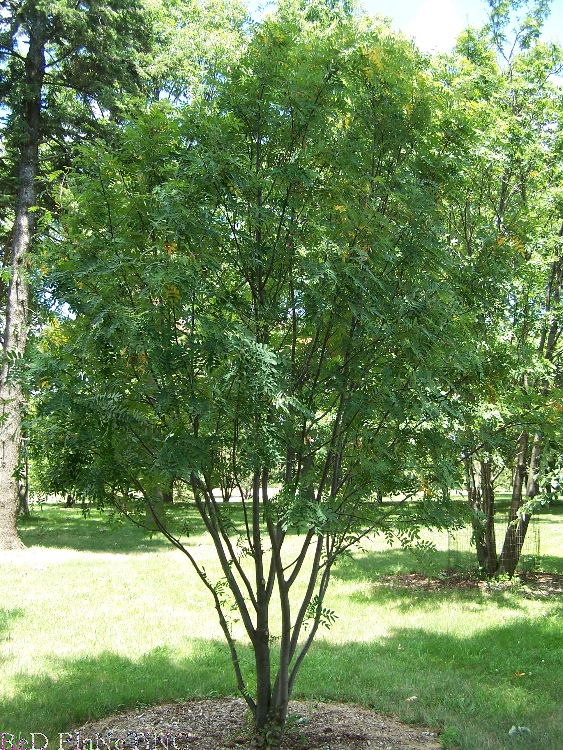
It needs full sun but does not like intense heat and should be watered well and mulched during periods of dry weather. Pruning, if necessary, should be done in early spring or winter. Tolerant of atmospheric pollution, and suitable as specimen trees in small gardens in the city. They are also ideal for wild or woodland gardens. (1) 

References:
1. Royal Horticultural Society
5. University of Michigan, Native American Ethnobotany
 

MORE TrEES


       web       www.cirrusimage.com