Hobei Elm – Ulmus lamellosa
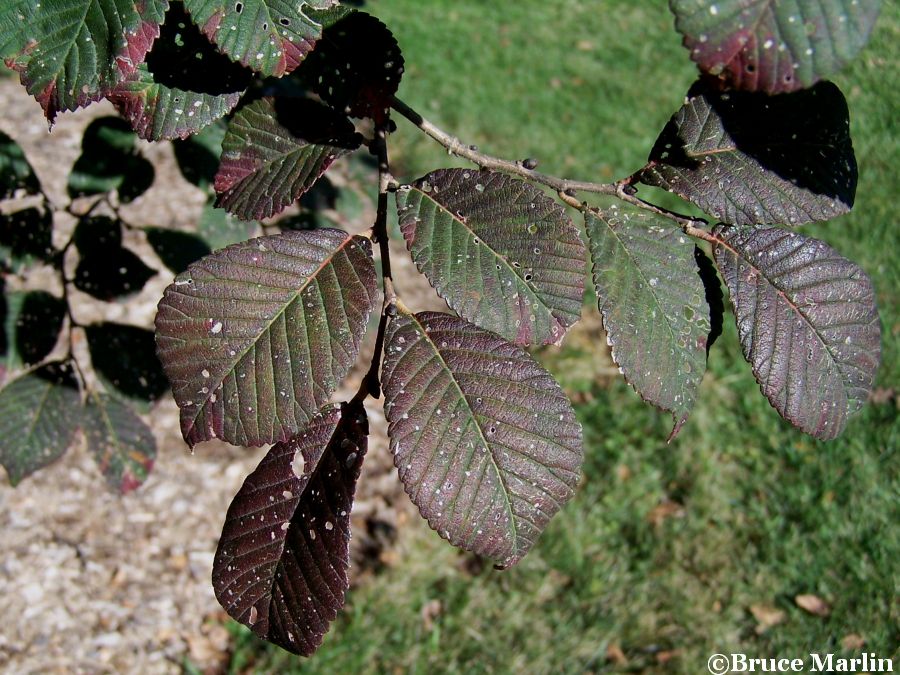
Foliage does not look so hot
Family Ulmaceae – Zelkova, Hackberry, Elm
Also commonly called Hebei elm. Range: Europe USDA Hardiness Zone: 4-7
A slow growing tree to 10 m, U. lamellosa is single or multi-stemmed, its upright branches forming a rounded crown. The leaves, on 3 mm – 8 mm petioles, are obovate, < 10 cm long by 5.5 cm wide, caudate at the apex, with simply to doubly serrate margins, and densely pubescent when young.
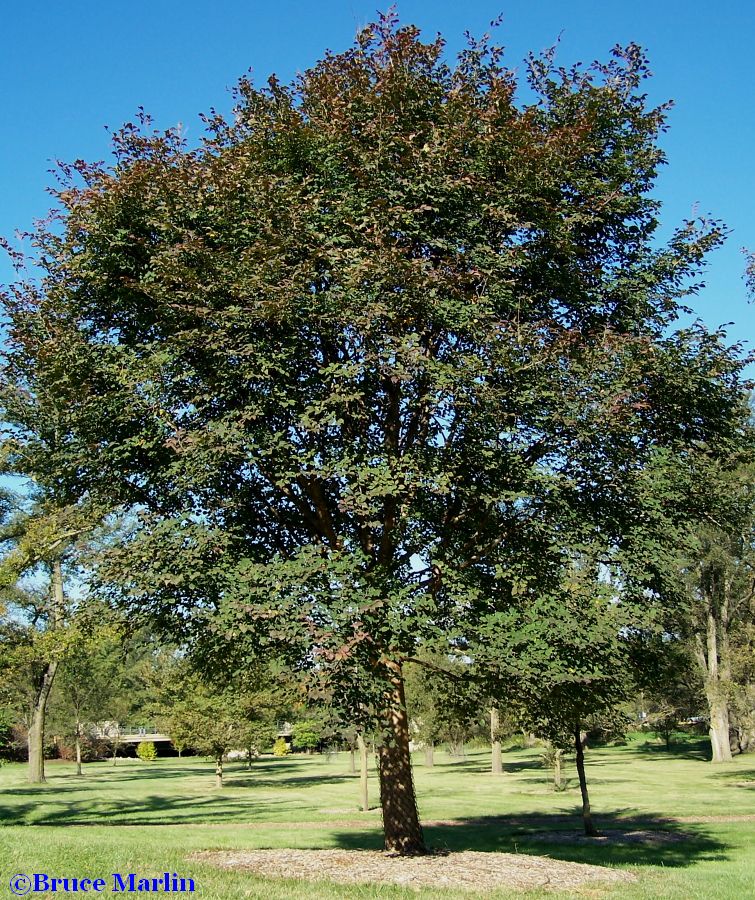
Hobei Elm, Morton Arboretum accession 317-90*1 is 30 years old
Rare in cultivation beyond China, it is one of a number of Chinese species which were assessed for their horticultural merit at the Morton Arboretum where it was adjudged suitable for planting in parks and gardens, but typically intolerant of wet soils. Although known to propagate satisfactorily, U. lamellosa is only very rarely found in commerce in Europe and the USA; there are no known cultivars.
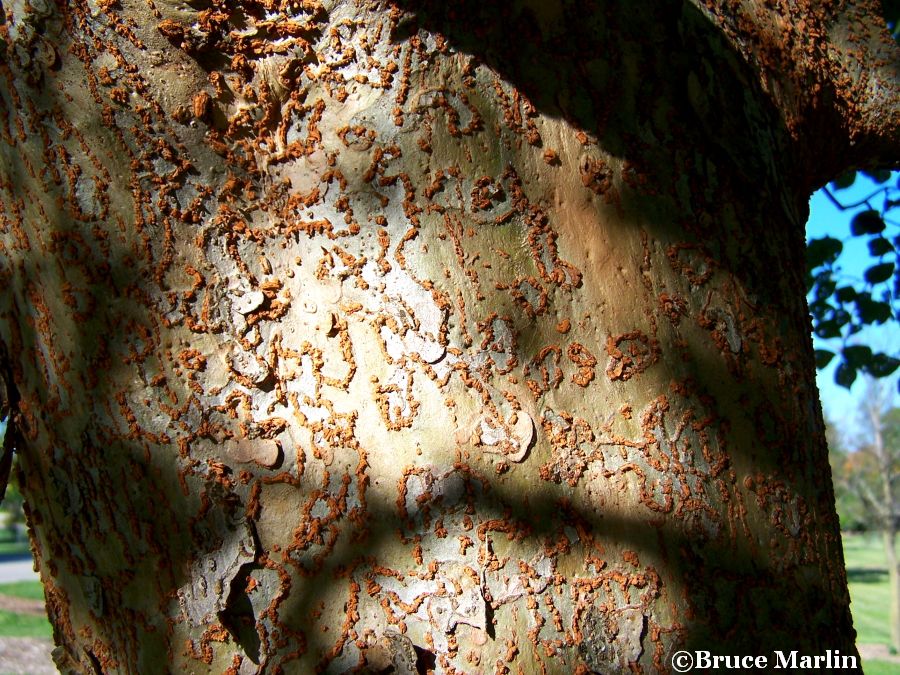
Hobei Elm bark has an interesting exfoliating, mottled pattern that is a hallmark of the clade
The Ulmus glabra / Ulmus minor clade comprising Ulmus glabra, U. procera [= U. minor], U. hollandica (U. glabra U. minor), and one of our (Morton Arboretum) U. pumila accessions is strongly supported (bootstrap = 0.97). This clade falls sister to a clade comprising U. foliacea, U. sukaczevii [= U. glabra], U. elliptica [= U. glabra], U. wallichiana (perhaps sister to U. elliptica, though this bears investigation with additional material). U. pumila, U. microcarpa, U. glaucescens var. lasiocarpa, U. lamellosa. Within this latter clade, Ulmus glaucescens var. lasiocarpa and U. lamellosa come out sister to one another, which is supported by a very distinctive bark character. [4]
The Morton Arboretum, at Lisle, Illinois, is home to the largest Elm collection in North America (www.cirrusimage.com has detailed studies of nearly 20 of these species, as well as numerous hackberries and zelkovas). Under study, the collection includes almost all of the 22 Elm species native to China, a dozen of which show resistance to Dutch elm disease and elm yellows. The Arboretum in past years has bred and marketed five new elm varieties resistant to Dutch elm disease. [2]
References
- Hobei Elm, Morton Arboretum accession 317-90*1, photos by Bruce Marlin
- The Morton Arboretum, Arboretum Records Honor, Milestone; Looks to Future
- USDA, NRCS Plants Profile, “Rock Elm, Ulmus thomasii Sarg.”
- Andrew L. Hipp, Linus Gog, Jaime A. Weber, and Alicia B. Giesler, “Evaluating the taxonomy of elms (Ulmus) using DNA sequence data”
Family Ulmaceae – Zelkovas, Hackberries and Elms
There are about 200 species of trees and shrubs in Ulmaceae. Elms fell victim to Dutch Elm disease during the 1950s; until that time, they were the premier shade tree along the streets of our American towns and cities. The Morton Arboretum in past years has bred and marketed five new elm varieties resistant to Dutch elm disease. Insects & Spiders Home | Elm Index | Tree Encyclopedia | Trees Index