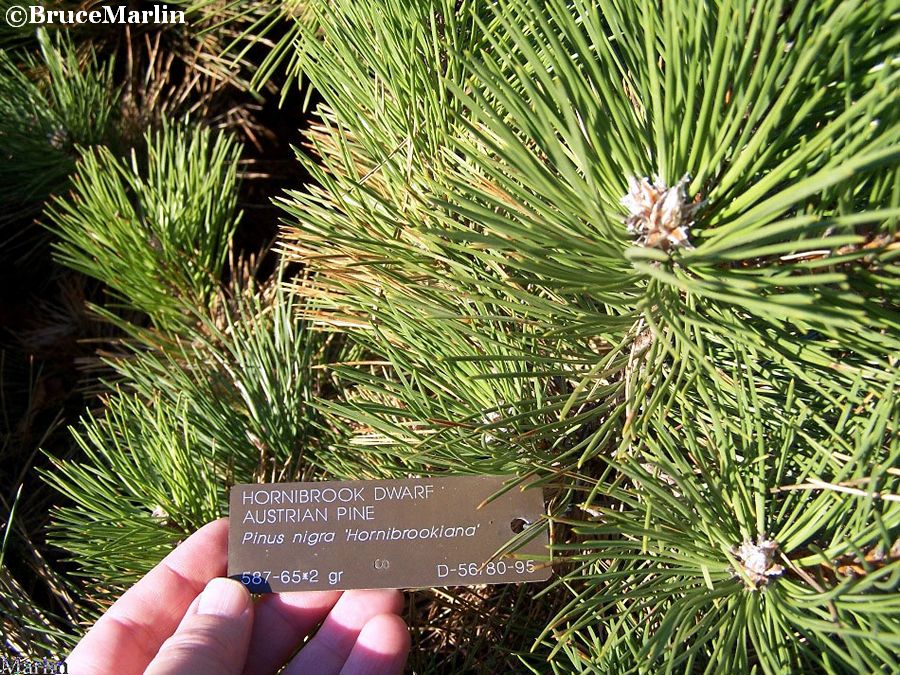
Hornibrook Dwarf Austrian Pine – Pinus nigra ‘Hornibrookiana’
Family Pinaceae: Pine, Cedar, Spruce, Fir
After Murray Hornibrook, an authority on dwarf pines.
‘Hornibrookiana’ originated from a witch’s broom on an Austrian pine in New York’s Seneca Park in 1932. This wonderful mounding shrub starts out as wide as it is tall, and has long, stiff, dark green needles that are retained all year, even in cold, windy climates. Its needles grow in bundles of two and are approximately two to three inches in length. The compact habit is easily maintained at the desired size, but will generally mature at two feet tall by three feet wide.
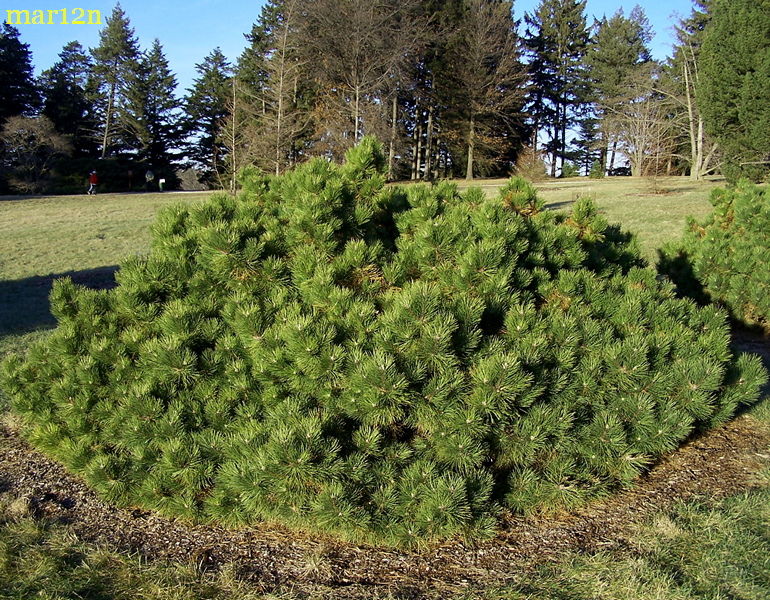
Austrian Pine grows best in full sun. Prefers moist soil with good drainage, but adaptable. Pinus nigra has a very discontinuous range, it is found in southern Europe (from the Pyrenees Peninsula to Sicily, Greece and Bulgaria), northwest Africa (Algeria and Morocco) and Asia Minor. There are several subspecies and varieties.
Trees Index | Pine Family | Beech, Oak | Nut Trees | Birch Family | Magnolias | Rose Family
Tree Encyclopedia / North American Insects & Spiders is dedicated to providing family-friendly educational
resources for our friends around the world through large images and macro photographs of flora and fauna.
Online since 2002