Chinese Catalpa – Catalpa ovata
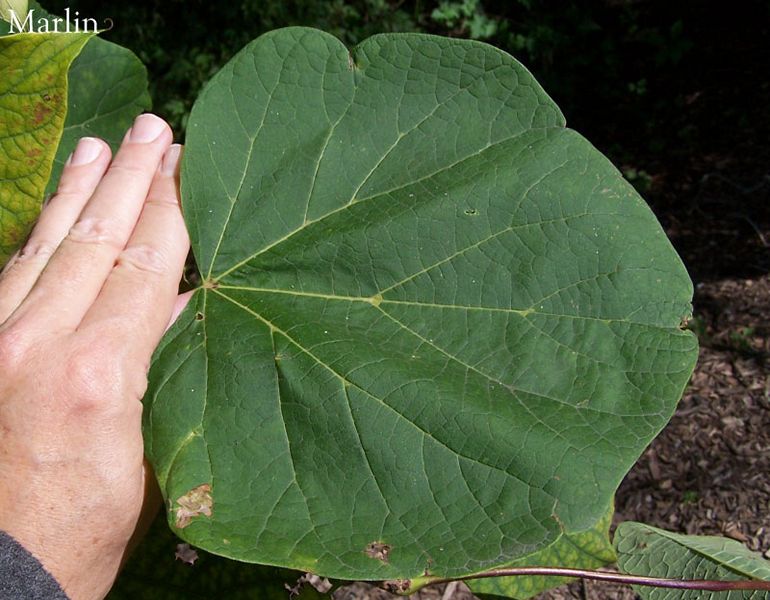
Trees to 15 m tall; young branches sparsely pubescent. Leaves opposite or nearly so, sometimes whorled; petiole 6-18 cm; leaf blade broadly ovate, ca. 25 X 25 cm, scabrous, sparsely pubescent, or glabrescent, base cordate, margin entire or sinuolate, usually 3-lobed, apex acuminate; lateral veins 4-6 on each side of midrib, palmately 5-7-veined basally. Inflorescences paniculate, terminal; peduncle sparsely pubescent, 12-28 cm. Calyx bilabiate, 6-8 mm. Corolla campanulate, pale yellow, yellow 2-striate and purple spotted at throat, ca. 2.5 X 2 cm. Anthers divergent. Style filiform; stigma 2-lobed. Capsule linear, nodding, 20-30 cm X 5-7 mm. Seeds long ellipsoid, 6-8 X ca. 3 mm, villous at both ends. Fl. May-Jun, fr. Aug-Oct. 2n = 40*.
The fruit are used medicinally as a diuretic.
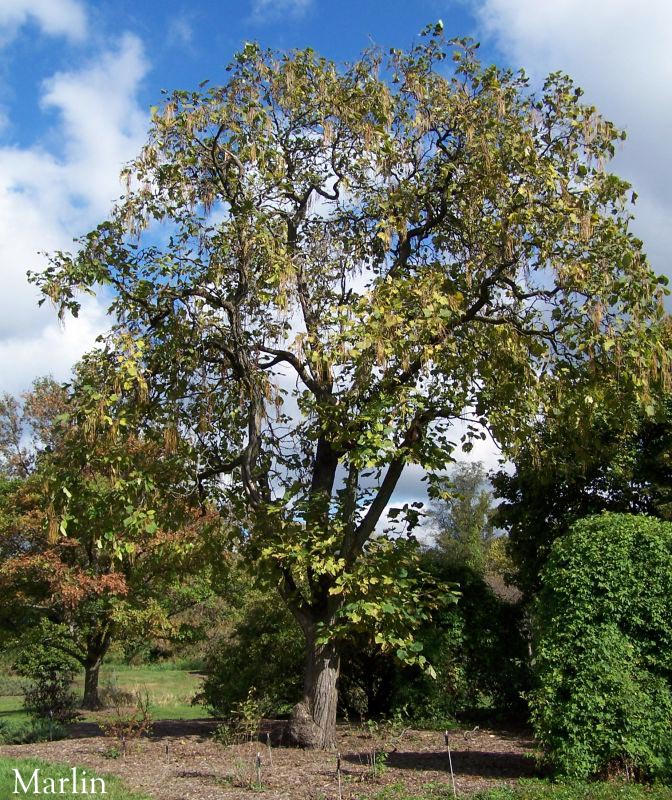
Catalpa, also spelled Catawba, is a genus of flowering plants in the trumpet vine family, Bignoniaceae, native to warm temperate regions of North America, the Caribbean, and east Asia. Catalpas are deciduous trees that grow to 18 metres (59 ft) tall and 12 metres (39 ft) wide. A 10-year-old sapling will stand about 6 metres (20 ft) tall. They can be recognized by their large heart-shaped to three-lobed leaves, showy white or yellow flowers in broad panicles, and in the autumn by their 20 – 50 centimetres (7.9 – 20 in) long fruits which resemble a slender bean pod, containing numerous small flat seeds, each seed having two thin wings to aid wind dispersal.
Catalpas are the host plant for the Catalpa Sphinx moth (Ceratomia catalpae), the leaves being eaten by the caterpillars. When caterpillars are numerous, infested trees may be completely defoliated. Defoliated catalpas produce new leaves readily, but with multiple generations occurring, new foliage may be consumed by subsequent broods. Severe defoliation over several consecutive years can cause death of trees. Because the caterpillars are an excellent live bait for fishing, some dedicated anglers plant catalpa mini-orchards for their own private source of “catawba-worms,” particularly in the southern states.
The largest living Catalpa tree is on the grounds of the Michigan State Capitol in Lansing, Michigan and was planted in the year of its dedication, 1879. The oldest is the 150-year-old specimen in the Minster graveyard of St Mary’s Butts in the English town of Reading in Berkshire, although this is soon to be replaced, passing the claim to Rochester’s 140-year-old Catalpa situated in front of the town’s Cathedral.
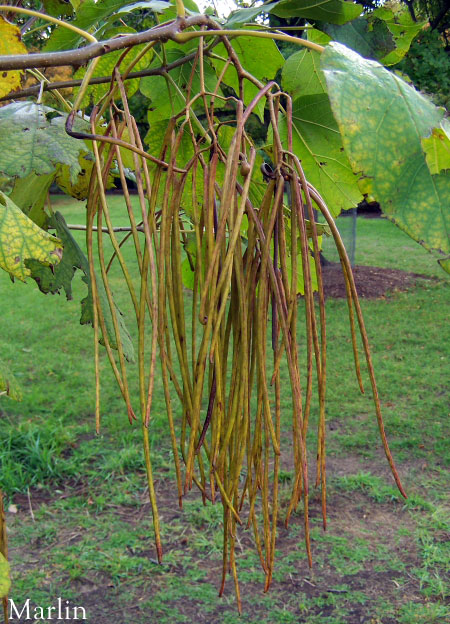 Chinese catalpa fruit grows to 20 inches long |
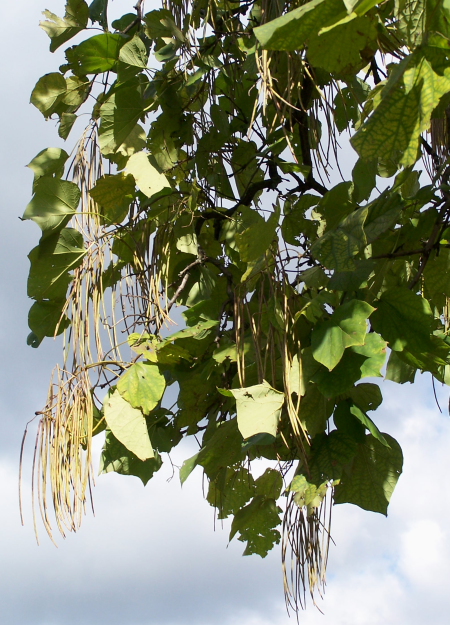 Chinese catalpa foliage and fruit |
References
- Chinese Catalpa – Catalpa ovata, Morton Arboretum acc. 518-22*2 photographed by Bruce Marlin
- eFloras.org, Chinese Plant Names, “Catalpa ovata G. Don“
- USDA, ARS, National Genetic Resources Program, “Taxon: Catalpa bungei C. A. Mey.”
- Arbor Day Foundation, What is my arborday.org hardiness zone?
- Wikipedia, “Catalpa“
Tree Encyclopedia | Trees Index | Maple | Fruit Trees | Nut Trees
Family Rutaceae – Cork & Citrus
Plants in this family are herbs, shrubs, and trees with commonly odoriferous herbage comprising about 150 genera and 1,500 species; further characterized by the common occurrence of spines and winged petioles. The Citrus genus includes the agriculturally important fruit trees: orange, lime, grapefruit, kumquat, and mandarine