Baldcypress - Taxodium distichum
Native to North America, Bald-cypress can grow to 150 ft. [2]
Family: Cupressaceae
Insects & Spiders Home | Family Cupressaceae | Ulmaceae Index | Tree Encyclopedia | Trees Index
Baldcypress Foliage
Hardy in zones 5-10.

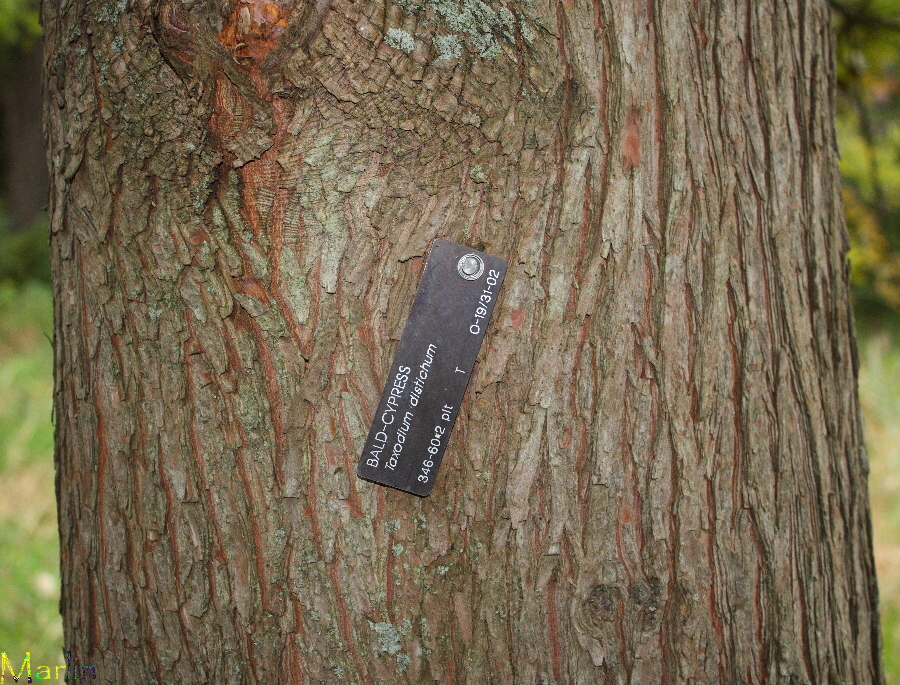
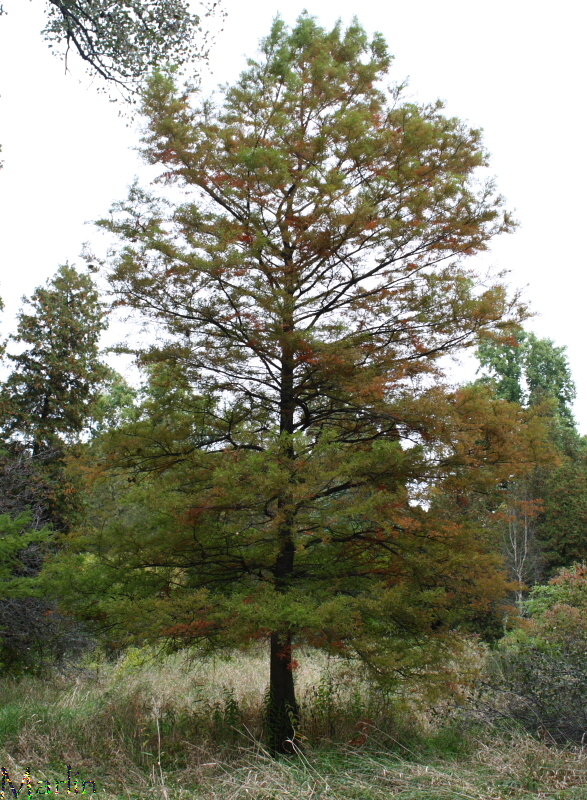
Narrowly to broadly pyramidal when young, Baldcypress, the state tree of Louisiana, eventually develops into a broad-topped, spreading, open specimen when mature. Capable of reaching 100 to 150 feet in height, most landscape specimens are rarely seen in this open form because they are usually much younger and shorter. Trees grow at a moderately fast rate, reaching 40 to 50 feet in about 15 to 25 years. Although it is native to wetlands along running streams, growth is often faster on moist, welldrained soil. The pale green, needle-like leaves turn a brilliant coppery red in fall before dropping, but the bare branches and reddish gray, peeling bark provide much landscape interest during the winter. The trunk grows unusually thick toward the base, even on young trees. The small seeds are used by some birds and squirrels.

Baldcypress Tree
This Baldcypress at the Morton Arboretum is 50 years old

USE AND MANAGEMENT
Although often seen at water’s edge where it will develop "knees", or root projections, that will extend above the water, Baldcypress can also be grown in dry locations and makes an attractive lawn, street, or shade tree. Cypress knees do not generally form on these drier sites. Cities from Charlotte, NC, Dallas, TX to Tampa, FL currently use it as a street tree and it should be used more extensively throughout its range in urban landscapes. It provides a good vertical accent to the landscape and should be used more often in urban areas. Baldcypress can be clipped into a formal hedge, creating a wonderful soft screen.
Surprisingly, the roots do not appear to lift sidewalks and curbs as readily as some other species. Its delicate, feathery foliage affords light, dappled shade, and the heartwood of Baldcypress is quite resistant to rot. However, most lumber available at lumber yards today is sapwood and is not resistant to rot. Baldcypress is ideal for wet locations, such as its native habitat of stream banks and mucky soils, but the trees will also grow remarkably well on almost any soil, including heavy, compacted, or poorly-drained muck, except alkaline soils with a pH above 7.5. Locate where the sun will strike the tree on all sides for best symmetrical development. Baldcypress is relatively maintenance-free, requiring pruning only to remove dead wood and unwanted lower branches which persist on the tree. It maintains a desirably straight trunk and a moderately dense canopy and does not form double or multiple leaders as do many other large trees.

The cultivar ‘Monarch of Illinois’ has a very widespreading form and ‘Shawnee Brave’ has a narrow, pyramidal form, 15 to 20 feet wide. ‘Pendens’ has drooping branchlets and large cones. Taxodium
distichum var. nutans (Taxodium ascendens) is native to wet, boggy areas with standing water, whereas Taxodium distichum is more common along streams. Propagation is by seed.

Pests
Bagworms can defoliate portions of the tree. Mites can be particularly troublesome in dry summers without irrigation, causing early leaf browning and defoliation in mid to late summer.

Diseases
Twig blight is caused by a weak pathogen and is usually present on dead or dying tissue. When the tree is stressed the fungus can kill branch tips. Dead tips can be pruned off. Do not let dead or diseased branches remain on the tree. Keep trees healthy with regular fertilization.


Baldcypress Bark
Bald Cypress Bark

References
  1. Baldcypress, Morton Arboretum acc. 346-60*2, photographed October 12, 2009 by Bruce Marlin
  2. Edward F. Gilman and Dennis G. Watson, USDA Forest Service Fact Sheet ST-620, "Taxodium distichum Baldcypress"
Insects & Spiders Home | Family Cupressaceae | Ulmaceae Index | Tree Encyclopedia | Trees Index

Custom Search
© Red Planet Inc.