Port Orford Cedar - Chamaecyparis lawsoniana (A. Murr.) Parl.
Cupressaceae -- Cypress family
Port-Orford-cedar, also called Lawson cypress and Port Orford white-cedar, is known for its grace in ornamental plantings and for its versatile wood. Mostly exported to Japan, it brings higher prices than almost any other conifer in the United States. (1)
 

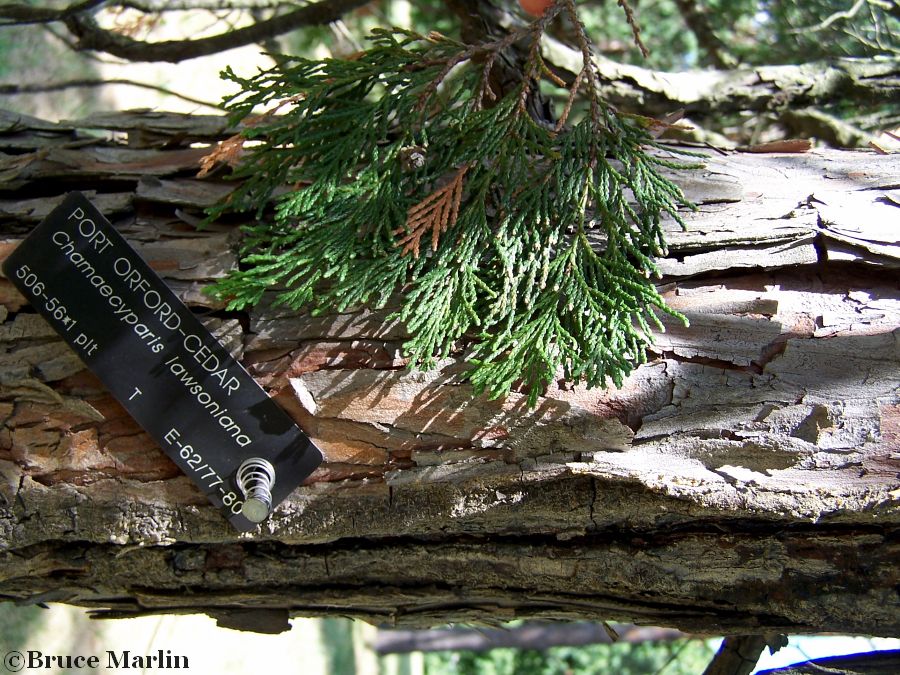
Port Orford Cypress foliage and bark
This Port Orford Cedar is a Morton Arboretum specimen.

Port-Orford-cedar, also called Lawson cypress and Port Orford white-cedar, is known for its grace in ornamental plantings and for its versatile wood. As logs, mostly exported to Japan, it brings higher prices than almost any other conifer in the United States. This valuable tree, however, has a very limited range and an uncertain future. Management of Port-Orford-cedar has become impossible in much of its range since the introduction of a fatal root rot that is still spreading. Old-growth forests are being depleted rapidly, and the use of second-growth forests is complicated because early growth is relatively slow. The commercial future of one of the most beautiful and potentially useful trees will depend on development of silvicultural practices that minimize infection by root rot.
Flowering and Fruiting- Pollen and seed cones develop on the same branches of this monoecious species. Reproductive organs are initiated in late spring or summer. They soon protrude beyond the surrounding leaves, and development continues through the summer. The bladderless pollen is formed in late winter in the bright red pollen cones; on the Oregon coast it is shed about mid-March. Fertilization occurs a month or more later, and seeds mature in September or October of the same season (5,13). Each fertile scale of the 7 to 10 scales in the globose cone usually bears 2 to 4 seeds. Cones contain about 20 percent of their weight in seeds.

Seed Production and Dissemination- Seed production starts when the tree is 5 to 20 years old (5). It can be induced in trees as young as 7 months with sprays of 50 p/m gibberellic acid (the effect is enhanced by Ethrel) with the correct photoperiodic regime. (At least 2 weeks of long days are required after gibberellin treatment, followed by at least 2 weeks of short days, followed by long days to allow cone maturation.)

Damaging Agents- The major causes of damage to Port-Orford-cedar are fungi of the genus Phytophthora (11,13). An exotic root rot caused by P. lateralis was introduced into Coos County about 1952 and has decimated many stands in the area where Port-Orford-cedar grows best. Neither resistance to the rot nor effective treatment of it has been identified. Spores of the fungus are carried by water, so one introduction of the disease may spread to all stands in the watershed below. Natural uphill spread is slow. Infections are carried uphill rapidly or between watersheds in mud on equipment or livestock; they have reached northern Del Norte County, CA. Many isolated stands or those uphill from infection centers, however, may be kept free of the disease by careful exclusion of contaminated machinery, livestock, and nursery stock.

Phytophthora cinnamomi causes major losses to some nurseries and cultivated trees. A white pocket top rot, caused by an unidentified fungus, is a serious problem. Losses to other diseases and to insects are minor (13). Animal damage to planted seedlings is highly variable, sometimes more and sometimes less than on associated conifers. (1)

Port Orford Cypress Foliage

Port-Orford cedar grows in a small area near the Pacific coast, from about latitude 40° 50' to 43° 35' N. in southern Oregon and northern California. It is most important on uplifted marine terraces and in the Coast Ranges of southern Coos County and northern Curry County, OR. A secondary concentration is found at high elevations in the upper reaches of the Illinois and Klamath River drainages near the Oregon State boundary. Throughout the rest of its range, Port-Orford-cedar is found as small, scattered populations, most common in the drainages of the middle Rogue, upper Illinois, Smith, lower Klamath, and lower Trinity Rivers. A major inland disjunction includes small populations of the upper Trinity and Sacramento River drainages southwest of Mount Shasta, CA.


Port-Orford cedar grows on many geologic and soil types: sand dunes; bogs, margins of intermittent streams, and drier sites on ultramafic rocks; and productive soils on sedimentary rocks and diorite. The largest trees are found on deep soils weathered from sedimentary rocks in Coos County, OR. The species is also found on sedimentary rocks near the lower Klamath River in California. Throughout much of its range, it is restricted to areas with consistent seepage within a meter of the soil surface. South of Coos County, OR, it is most common on wet spots on ultramafic rocks, especially at lower elevations in the inland and southern parts of its range. Reportedly, Port-Orford-cedar grows on soils in the orders Spodosols, Ultisols, and Inceptisols.

Associated Forest Cover
Port-Orford-cedar is found with an extremely wide variety of associated plants and vegetation types. It usually grows in mixed stands and is important in the Picea sitchensis, Tsuga heterophylla, mixed evergreen, and Abies concolor vegetation zones of Oregon and their counterparts in California. It also grows in a variety of minor communities from dry sand dunes to Darlingtonia (cobra-lily) bogs. The species reaches its greatest size and commercial worth in the dense, rapidly growing forests of the Picea sitchensis and the Tsuga heterophylla zones, in which Douglas-fir often dominates. Port-Orford-cedar is most dominant on wet soils, most of which have parent material at least partially ultramafic, in the high elevation Abies concolor zone where forests are dense but slow growing. In the mixed evergreen zone, it is the only shade-tolerant conifer in most stands. On drier sites on ultramafics and in bogs, forests can be very open and slow growing. The cedar is dominant in the forest cover type Port-Orford-Cedar (Society of American Foresters Type 231) and is listed as a minor associate for parts of the following types: Sitka Spruce (Type 223), Pacific Douglas-Fir (Type 229), Redwood (Type 232), Oregon White Oak (Type 233), and Douglas-Fir-Tanoak-Pacific Madrone (Type 234). (1)

Special Uses
Outside its natural range, the major use of Port-Orford-cedar is as an ornamental (13). As such, it is usually referred to as Lawson cypress. More than 200 cultivars are known, varying in size, shape, foliar morphology, and color. It is suitable for hedges but is usually planted as separate individuals of either full-sized or dwarfed varieties. Its use has declined in some areas because of root rot. Cut branches are used in floral arrangements.
 

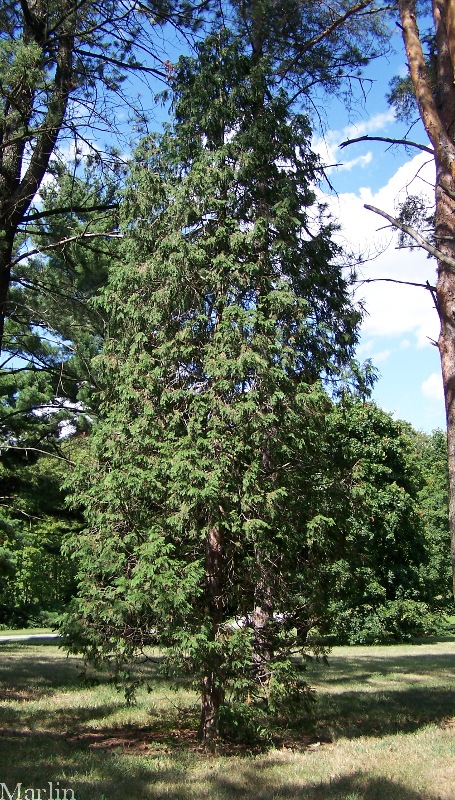
Port Orford Cypress
This Port Orford Cedar has been vetted by a Morton Arboretum arborist.  It was planted 51 years ago.


       web      www.cirrusimage.com


[Cirrus Home]    [Butterflies]    [Bugs]    [Beetles]    [Mantids]    [Spiders]    [Bees & Wasps]    [Dragon & Damselflies]    [Moths]   [Wildflowers]
[Fungi & Mushrooms]    [Flies]   [Butterflies of the World]  [Trees of North America]  [Cicadas & Grasshoppers]   [Ticks & Mites] 

© Red Planet Inc.