 |
Norway Spruce - Picea abies
Pinaceae – Pine family
Norway spruce, native to Europe, has become locally
naturalized, at least in north central United States and
Canada.
The species is the most widely cultivated spruce in North
America; many cultivars exist, including dwarf shrubs.
|
|
|
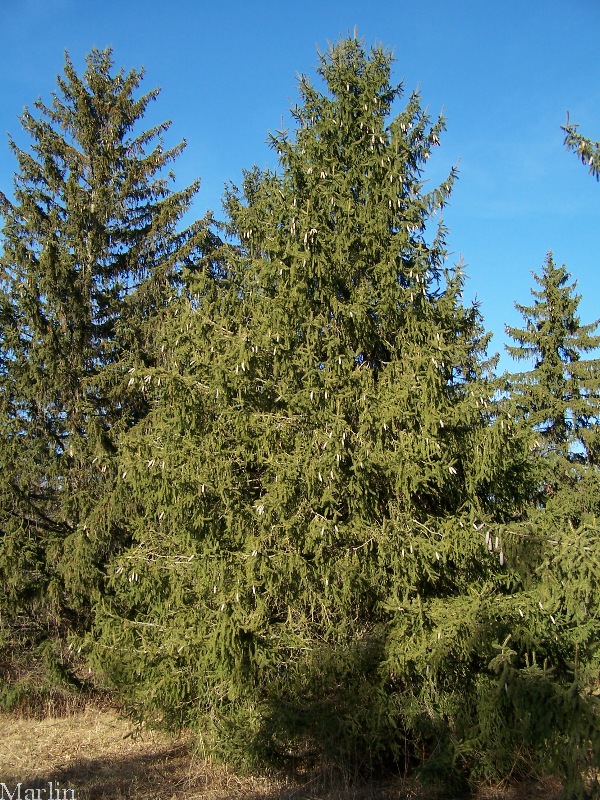
This is part of a dense stand at the Morton Arboretum, near
Hemlock Hill
|
|
Norway Spruce can grow 80 to 100
feet tall and spread 25 to 40 feet, though some
listed cultivars are shrublike. Small-diameter
branches sweep horizontally from the straight trunk
which can grow to four feet thick. Branchlets droop
from the branches toward the ground in a graceful,
weeping fashion forming a delicate pyramid. On very
old specimens the lower branches increase to 12" or
more in diameter and the top becomes open. Many
small-diameter roots originate from the base of the
trunk and they are often found fairly close to the
surface of the soil. The root system is shallow and
often dense, particularly close to the trunk which
makes growing grass difficult.
Norway spruce is native to the
European Alps, the Balkan mountains, and the
Carpathians, its range extending north to
Scandinavia and merging with Siberian spruce (Picea
obovata) in northern Russia. It was introduced to
the British Isles as early as 1500 AD, and is widely
planted in North America, particularly in the
northeastern United States, southeastern Canada, the
Pacific Coast states, and the Rocky Mountain states.
Naturalized populations are known from Connecticut
to Michigan and probably occur elsewhere.
In its native range, Norway spruce occurs in pure
stands, transitional stands mixed with Scotch pine
(Pinus sylvestris), or mixed stands with European
beech (Fagus sylvatica) and European silver fir
(Abies alba). Scattered Norway spruce occurs in
seral stands of European aspen (Populus tremula) or
hairy birch (Betula pubescens). Classification
systems for Scandinavian forests where Norway spruce
and/or Scotch pine are the major species are based
on ground vegetation. Common groundlayer species
include bilberry (Vaccinium myrtillus), lingonberry
(V. vitis-idaea), heather (Calluna vulgaris), and
woodsorrel (Oxalis spp.). Good sites for Norway
spruce occur on Oxalis-Myrtillus types and fair
sites are indicated by Myrtillus. Vaccinium types
are usually rather barren and not suited for good
spruce growth. Understory species most often
associated with Norway spruce in Poland include
raspberry (Rubus idaeus) and European mountain-ash
(Sorbus aucuparia). Mature Norway spruce forests
typically have very little groundlayer vegetation.
Norway spruce wood is strong, soft, straight- and
fine-grained, and easily worked. It is not durable
in contact with soil. It is widely used for
construction, pulp, furniture, and musical
instruments. Norway spruce is one of the most common
and economically important coniferous species in
Europe and Scandinavia. In Maine, thinned material
and standing dead Norway spruce produced pulp of
good strength as reported in a study of the pulp
potential of seven softwoods. |

Leaf arrangement: alternate; spiral. Leaf type: simple. Leaf
margin: entire. Leaf shape: needle-like (filiform) Leaf
venation: parallel
Leaf type and persistence: evergreen; needle leaf evergreen.
Leaf blade length: less than 2 inches
|
IMPORTANCE TO LIVESTOCK AND
WILDLIFE : Norway spruce seedlings are highly
preferred winter browse for snowshoe hares in
Quebec. Browsing of seedlings and saplings in
plantations can be intense, as young plantations
form ideal winter habitat for snowshoe hares.
Norway spruce is not a preferred browse for
moose in Scandinavia; young and middle-aged
stands of Scotch pine form habitat preferred by
moose over mature Scotch pine-Norway spruce
forests and bogs. In Europe, red deer strip the
bark of Norway spruce. Other animals browse
spruce foliage but it is not a highly preferred
food source for either wildlife or domestic
animals. Norway spruce provides important winter
cover for a number of species of wildlife.
Grouse eat spruce leaves and the seeds are
consumed by a number of birds and small mammals.
Norway spruce has been planted for windbreaks
and shelterbelts in western prairies, although
it grows better in more humid environments. It
is recommended for shelterbelt plantings in
humid, severe-winter regions. Norway spruce is
widely planted for Christmas trees and as an
ornamental. Norway spruce roots can be used as
grafting stock for white spruce (Picea glauca).
Norway spruce resin has been used to make
Burgundy pitch, and the twigs used to make Swiss
turpentine. The twigs and needles were used to
make antiscorbutic and diuretic beverages..
(3) |
|
|
|
- Native:
- EUROPE
Northern Europe: Finland;
Norway; Sweden
Middle Europe: Austria;
Czechoslovakia; Germany;
Hungary; Poland; Switzerland
East Europe: Belarus;
Estonia; Latvia; Lithuania;
Russian Federation - European part
Southeastern Europe:
Albania; Bulgaria; Greece;
Italy; Romania; Yugoslavia
Southwestern Europe: France
|
Synonyms:
(1) |
|
|
 |
|

Norway spruce is an introduced
evergreen tree. In central Europe,
heights of up to 203 feet (61 m) have
been reported; the range is usually
between 100 and 200 feet (30-61 m). The
bole is usually straight and
symmetrical, with no tendency to fork.
The bark of young trees has pale fine
shreds. The bark of older trees is
usually heavy with algae and has shallow
rounded scales that are easily shed. The
crown of young trees is narrowly conic,
that of older trees becoming broadly
columnar [50]. Secondary branchlets are
characteristically drooping or
pendulous. Norway spruce cones are
conspicuously large (4 to 7 inches
[10-18 cm] long). The root system is
typically shallow, with several lateral
roots and no taproot. On rocky sites the
roots spread widely, twining over the
rocks. On bog soils, Norway spruce tends
to form plate-like roots. In Finland, a
140-year-old Norway spruce forest in a
Vaccinium-Myrtillus vegetation type had
a root zone extending only 12 inches (30
cm) into mineral soil.
Early growth of Norway spruce is slow,
increasing to maximal rates from 20 to
60 years of age. Within its native
range, Norway spruce remains healthy up
to 200 years, and lives up to 300 to 400
years at the northern limits of its
range. Senescence occurs at less than
200 years of age in the British Isles
and North America.
Norway spruce first occurred in
Scandinavia approximately 2,500 years
ago; its immigration from Europe is
attributed to colder Scandinavian
winters coupled with increased
precipitation and storm events which
allowed Norway spruce to colonize areas
that were formerly too dry. It survived
in Scandinavia in low densities due to
frequent disturbances until climatic
changes coupled with a decrease in
human-caused disturbances (mainly fire)
allowed natural succession to proceed,
resulting in the current widespread
distribution of dense Norway
spruce-dominated forests.
|
|
|
References
1.
USDA, ARS, National Genetic Resources Program.
Germplasm Resources Information Network - (GRIN)
3.
USDA Fire Effects Information
Norway Spruce |
|
|
|