Hillspire Juniper- Juniperus virginiana 'Cupressifolia'
Family Cupressaceae. Also commonly called Eastern Red Cedar, savin, cedar apple, pencil cedar, or Virginia red cedar.
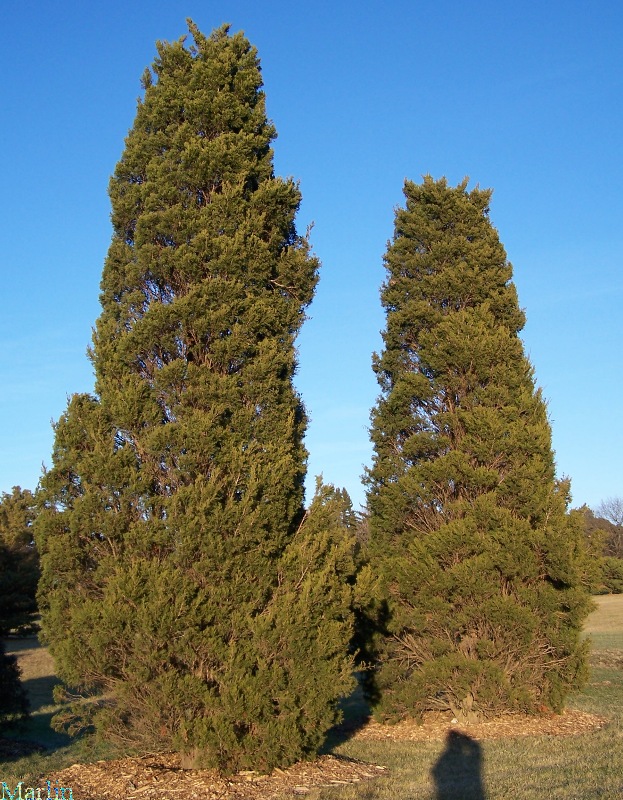
It is a slow-growing, narrow-leaved evergreen growing in a narrow pyramidal form to 45 feet. Native to North America east of the Rocky Mountains, and isolated populations in Oregon, this common tree was revered by Native Americans for its many and varied uses. (1)


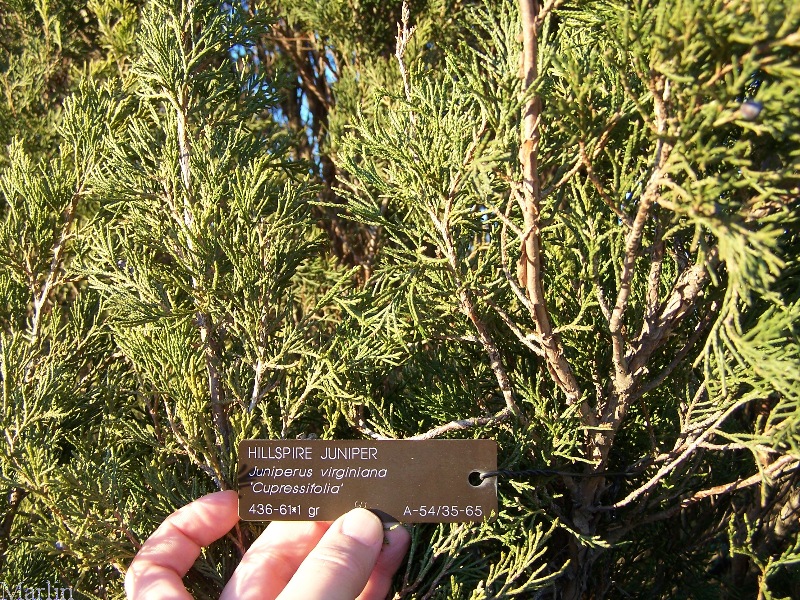
These Morton Arboretum specimens are variety 'Cupressifolia', commonly called Hillspire Juniper.
Showing mid-winter dark green foliage on Christmas day, they are nearly 50 years old.


Camera location 41.81787° N, -88.076819° E Google Maps - Live Maps - TopoZone - TerraServer-USA

 Description
Red cedar (Juniperus virginiana) is a medium-sized dioecious or rarely monoecious tree from 10-20 m (33-66') tall (McGregor et al. 1986, Stephens 1973). The evergreen tree is shaped like a pyramid or column, with reddish-brown to grayish colored bark that is fibrous and shedding. Branches are usually reddish-brown. Leave are opposite, simple, green or blue-green, closely appressed and overlapping the leaf above, scale-like, and 0.2-0.3 cm (1/16-1/8”) long or needlelike and 0.6-1.2 cm (1/4-1/2”) long. Male and female cones are on separate trees. The staminate (male) cones are yellowish-brown, papery, solitary at the tips of branchlets, ovoid to ellipsoid, and 0.2-0.4 cm (1/16-1/8”) long. The ovulate (female) cones are solitary at the tips of branchlets, dark blue or bluish-purple, waxy and berrylike, 0.4-0.7 cm (3/16-1/4”) long. The female cones ripen from September through October. There are 1-3 seeds per cone. Red cedar seeds are yellow-brown and round, 2-4 mm in diameter, ridged near the base, and sometimes shallowly pitted.

Distribution
The distribution of red cedar (Juniperus virginiana) spans the U.S. east of the Rockies. The species also occurs in Oregon in the west. The southern red cedar (var. silicicola) occurs only in the southeastern US. Red cedar is a pioneer species and often volunteers in old fallow farm fields and waste places.


Leaves scale-like, 1/16" long on younger branches, needle-like to 3/16" long on older sections of branches, scales held tightly in four rows, oval to
lanceolate shape and narrow acuminate tip (sharp-pointed). Opposite arrangement.

Uses
Ethnobotanic: The red cedar is used by many tribes for incense in purification and ritual (Kindscher 1992). For numerous tribes, the red cedar tree symbolizes the tree of life and is burned in sweat lodges and in purification rites. The Blackfoot made a tea from the berries of the red cedar to stop vomiting (Kindscher 1992). A Blackfoot remedy for arthritis and rheumatism was to boil red cedar leaves in water, add one-half teaspoon of turpentine, and when cooled, rub the mixture on affected parts. The Blackfoot also drank a tea made from red cedar root as a general tonic; mixed with Populus leaves this root tea became a liniment for stiff backs or backache (McClintock 1909, Johnston 1970, Hellson 1974).

The Cheyenne steeped the leaves of the red cedar and drank the resulting tea to relieve persistent coughing or a tickling in the throat. It was also believed to produce sedative effects that were especially useful for calming a hyperactive person. Cheyenne women drank the red cedar tea to speed delivery during childbirth (Grinnell 1962). The Cheyenne, along with the Flathead, Nez Perce, Kutenai, and Sioux, made a tea from red cedar boughs, branches, and fleshy cones, which they drank for colds, fevers, tonsillitis, and pneumonia (Hart 1976).

As a cure for asthma, the Gros Ventres ate whole red cedar berries or pulverized them and boiled them to make a tea. They also made a preparation from the leaves mixed with the root, which they applied topically to control bleeding (Kroeber 1908). The Crows drank this medicinal tea to check diarrhea and to stop lung or nasal hemorrhage. Crow women drank it after childbirth for cleansing and healing (Hart 1976).

The young leafy twigs of the red cedar were officially listed in the U.S. Pharmacopoeia from 1820 to 1894 as a diuretic (Kindscher 1992). The distilled oil of the red cedar has been officially listed as a reagent in the U.S. Pharmacopoeia since 1916 (ibid.).


The wood of red cedar is very durable, and was used for lance shafts, bows, and other items. Flutes made from red cedar wood were highly regarded by the Cheyenne. Cedar boughs were used for bedding. The Menomini wove mats of cedar bark. The mats were used for roofing temporary structures, for partitions, floor mats and wrappings, and for various purposes in the canoes.

Ornamental: Seedlings of red cedar are ordinarily used as stock for grafting ornamental juniper clones. Red cedars are often used as ornamentals for their evergreen foliage. Most cemetery plantings include old red cedar trees and many younger dwarf junipers. All of the native junipers are valuable ornamental species, and many horticultural varieties have been developed. Red cedar is widely used in shelterbelts and wildlife plantings. The close-grained, aromatic, and durable wood of junipers is used for furniture, interior paneling, novelties, and fence posts. The fruits and young branches contain aromatic oil that is used in medicines.

Wildlife: Red cedar and other junipers are important to wildlife throughout the country. Their twigs and foliage are eaten extensively by hoofed browsers, but the chief attraction to wildlife is the bluish-black berry-like fruit. The cedar waxwing is one of the principal users of red cedar berries, but numerous other birds and mammals, both large and small, make these fruits an important part of their diet. In addition to their wildlife food value, cedars provide important protective and nesting cover. Chipping sparrows, robins, song sparrows, and mockingbirds use these trees as one of their favorite nesting sites. Juncos, myrtle warblers, sparrows of various kinds, and other birds use the dense foliage as roosting cover. In winter, their dense protective shelter is especially valuable.
 

 Establishment
It is especially well adapted to dry areas. Red cedar is generally propagated by cuttings. Cuttings are made 5 to 15 cm (2 to 65 inches) long from new lateral growth tips stripped of older branches. A small piece of old wood, a heel, is thus left attached to the base of the cutting. Some propagators believe this to be advantageous. In other cases, good results are obtained when the cuttings are just clipped without the “heel” from the older wood. Cuttings from the current season’s terminal growth also root well.

Cuttings to be rooted in the greenhouse can be taken at any time during the winter or rooted outdoors on heated beds. Exposing the stock plants to several hard freezes seems to give better rooting. Optimum time for taking cuttings is when stock plants have ceased growth (i.e. the late fall-winter propagation period is more successful than summer). For propagating in an outdoor cold frame, cuttings are taken in late summer or early fall. There may be advantages to using bottom heat. Lightly wounding the base of the cuttings is sometimes helpful, and the use of root-promoting chemicals, especially IBA, is beneficial. Recommendations for root-promoting chemicals include the following: 2500 IBA Quick-dip (Alabama), 3000 – 8000 ppm IBA liquid, and 0.3-4.5 percent IBA talc. Medium-coarse sand or a 10:1 mixture of perlite and peat moss is a satisfactory rooting medium. Maintenance of a humid environment without excessive wetting of the cuttings is desirable, as is a relatively high light intensity. A light, intermittent mist can be used. Bottom heat of 60-65°F (12°C) is critical the first six weeks of propagation to allow the basal wound of cuttings to callus.

Seed Propagation
Juniperus virginiana flowers from March to May. The fruits should be gathered in the fall (September-November) as soon as the berry-like cones become ripe. Red cedar trees come to seed-bearing age in 10 years, and they bear cones every 2-3 years. Seed collection can be done by stripping or picking the berries by hand from the trees, or by flailing the fruits to ground cloths. Be careful to pick only ripe berries. Since the number of filled seeds varies widely from tree to tree, it is important to test the seeds by cutting to determine percent fill. Seeds may be stored as berries or cleaned seeds.

The seeds can be recovered by macerating the fruits and floating the seeds to the top. The addition of detergent to the maceration water helps to separate seeds from the resinous fruits. Red cedar seeds store quite well. They should be dried to 10-20% moisture and stored in a sealed container at cold temperatures.

For best germination, seeds should be removed from the fruits, then the seed coat is softened by treating it with sulfuric acid for 120 minutes. After soaking the seeds in sulfuric acid, follow with 6 weeks of warm stratification at 20 to 30°C (70 to 85°F), or summer planting, then 10 weeks of pre-chilling at 4°C (40°F). Use of fresh seed reduced the warm stratification time. Rather than the acid treatment, two to three months of warm stratification could be used. As an alternative for cold stratification, the seed may be sown in the fall. Germination is delayed at temperatures above 15°C (60° F). Germination is often delayed in red cedar seeds, as seeds are consistently highly dormant.

Red cedar seeds are usually sown in the nursery in the late summer or fall, but may be sown in spring or summer. The seeds of most species should be sown in fall to take advantage of natural pre-chilling. Red cedar seeds are usually drilled in well-prepared seedbeds in rows 15 to 20 cm apart and covered with 0.6 cm of soil. In nurseries with severe climates, such as those in the Great Plains, considerable care must be taken to protect the beds with mulch and snow fences.

Viability of the seed varies considerably from year to year and among lots, but it is never much over 50 percent. Treated seed is usually planted in the spring, either in outdoor beds or in flats in the greenhouse. Two or three years are required to produce plants large enough to graft.

Eastern Red Cedar is available through most nurseries. Cultivars include: Baker’s Blue, Blue Mountain, Brodie, Burkii, Canaerti, Cupressifolia, Dundee, Emerald Sentinel, Glauca, Gray Owl, Hillspire, Idyllwild, Manhattan Blue, Mission Spire, Nova, Pendula, Patt River, Princeton Sentry, Royo, Silver Spreader, Stover, and Taylor.


References:
1. USDA NRCS National Plant Data Center, Carlinville (IL) Field Office, & Missouri State Office


       web       www.cirrusimage.com