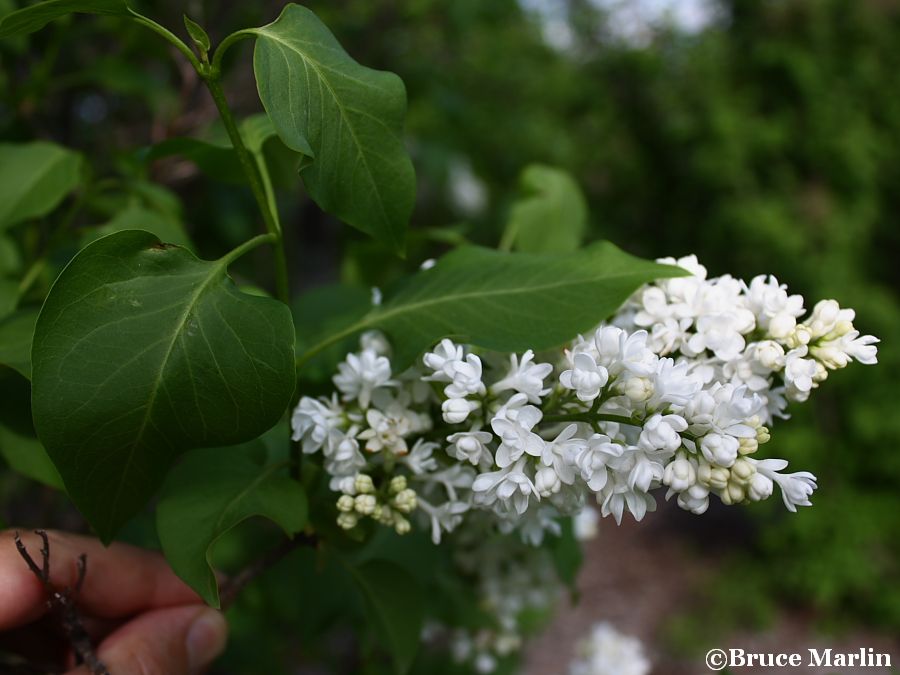
Common Lilac – Syringa vulgaris ‘General Sheridan’
Family Oleaceae – Olive, Ash, Lilac.
Famous for its abundant white double flowers and fragrance, it is named after Philip Henry Sheridan, a Union general in the American Civil War.
Syringa (Lilac) is a genus of about 20-25 species of flowering plants in the olive family, native to Europe and Asia. [4]
Lilacs are deciduous shrubs or small trees, ranging in size from 2-10 m tall, with stems up to 20-30 cm diameter. The leaves are opposite (occasionally in whorls of three) in arrangement, and their shape is simple and heart-shaped to broad lanceolate in most species, but pinnate in a few species (e.g. S. protolaciniata, S. pinnatifolia). The flowers are produced in spring, each flower being 5-10 mm in diameter with a four-lobed corolla, the corolla tube narrow, 5–20 mm long; they are bisexual, with fertile stamens and stigma in each flower. The usual flower colour is a shade of purple (often a light purple or lilac), but white, pale yellow and pink, and even a dark burgundy color are also found. The flowers grow in large panicles, and in several species have a strong fragrance. Flowering varies between mid spring to early summer, depending on the species. The fruit is a dry, brown capsule, splitting in two at maturity to release the two winged seeds.

The genus is most closely related to Ligustrum (privet), classified with it in Oleaceae tribus Oleeae subtribus Ligustrinae. Lilacs are used as food plants by the larvae of some Lepidoptera species including Copper Underwing, Scalloped Oak and Svensson’s Copper Underwing and Saras. [4]
References
- General Sheridan Common Lilac , Morton Arboretum acc. 788-73*1, photos by Bruce Marlin
- Morton Arboretum, Crabapples for the Home Landscape
- Wikipedia, the Free Encyclopedia, Oleaceae
- Wikipedia, Syringa
Family Oleaceae – Olive, Ash, Lilac and Privet
The olive family contains 25 genera and over 500 species of flowering plants. Most species are native to temperate and tropical regions of the Northern Hemisphere. The best known of this family are olive, ash, privet, lilac, and Forsythia.