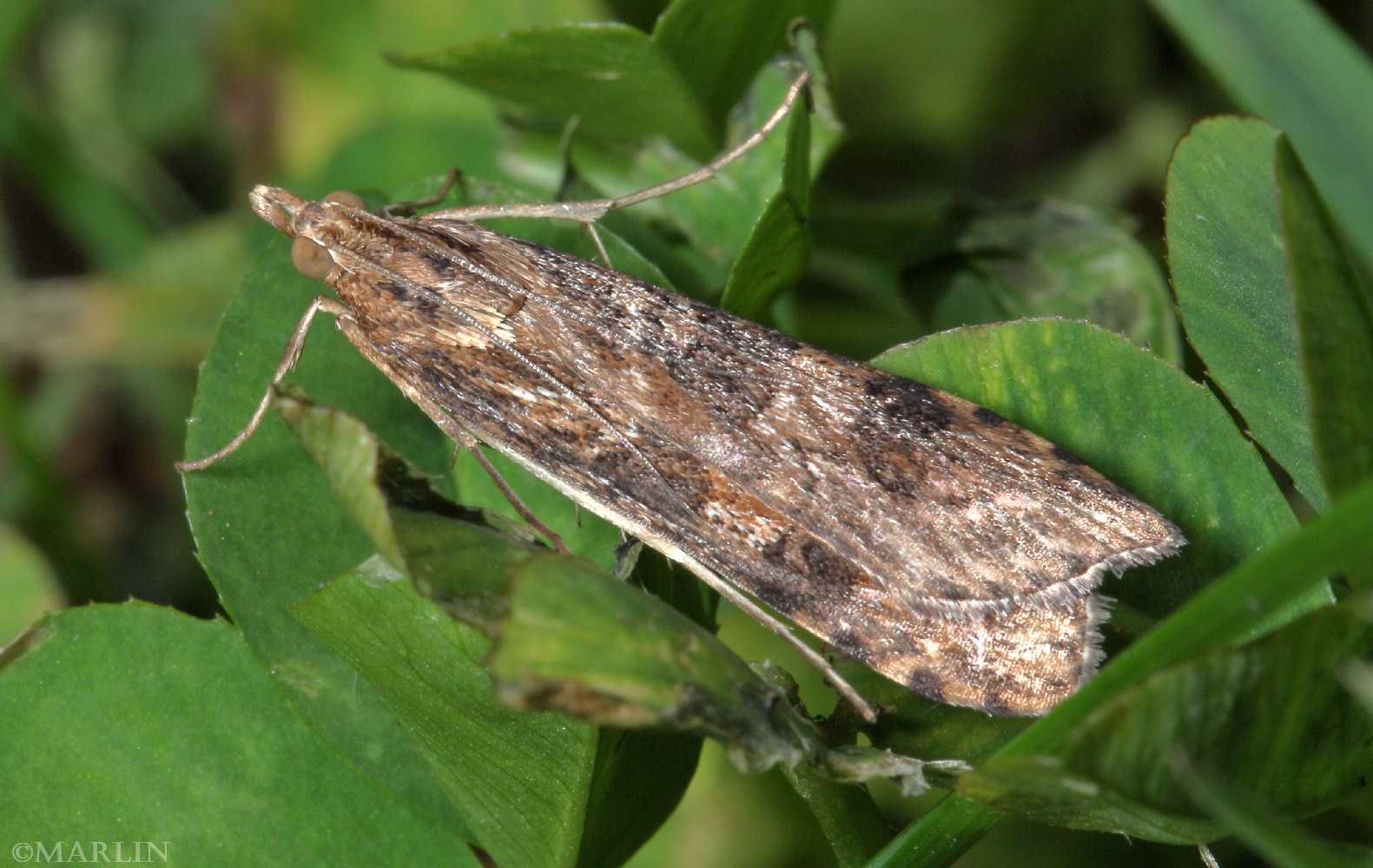
Lucerne Moth - Nomophila nearctica
Adult moth also known as Clover Nomophila or celery webworm moth. Larva commonly called false webworm, celery stalkworm, celery webworm. Live adult moths photographed at West Chicago Prairie, DuPage County, Illinois.
Cirrus Home | Butterflies Main | Moths | Moths Index | Skipper Butterflies | Butterflies Index

Lucerne Moth

Family Pyralidae: Pyralid moths. There are, worldwide, five subfamilies and at least 6,150 species. North America has approximately 565 species in five subfamilies.

The celery webworm is a pest on celery and alfala, among other vegetable and fodder crops [4].

The Pyralids are agricultural pests; some are leaf tiers or leaf rollers; the majority are borers in stems, seeds, buds, or flowers. Some are wood borers in the cambium layer, others feed on combs in bee hives or on dried plant materials. Many economically important species: Indian meal moth, Clover hay-worm, Zimmerman pine moth, Sunflower head moth.
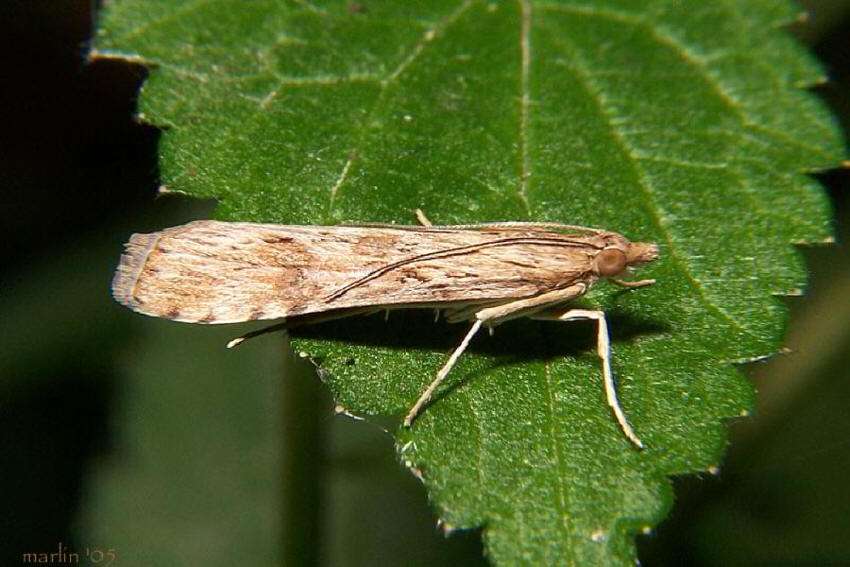
Lucerne Moth
Lucerne Moth - Nomophila nearctica

The "meal moth" Pyralis farinalis (below) is a particularly damaging Pyralid agricultural and food-supply pest. Farinalis gets its name from the Latin farina, a fine meal of vegetable matter (as cereal grains, nuts or sea moss). [2] This cosmopolitan moth hangs out mainly in homes, barns, and warehouses where can be found grain or processed grain products.  Larvae, which can grow to 20mm, feed on stored grain, flour,  corn meal and other milled grain products.

Meal moths attack stored grain products or household foodstuffs. Once established in food, insect populations can increase and infest vulnerable material throughout the home, apartment, or storage area. Some adult moths do fly into the home through open doors or windows, but most are carried inside from outdoor storage or in packaged goods or groceries. [3]

Meal Moth - Pyralis farinalis
Pyralis farinalis - Meal Moth - Hodges#5510

Everyone's home is vulnerable. However, those who do not store food properly have the greatest problems. Spilled or exposed foods attract the insects and increase the chance of infestation. Foods that are not tightly sealed, especially those maintained for long periods of time, are particularly susceptible to infestation.

The Indian meal moth and the Mediterranean flour moth are the most prevalent meal moths which infest foodstuffs in Washington. Several other moths that are found occasionally in foodstuffs include the meal moth, the white shouldered house moth, and the brown house moth. [3]

Lucerne Moth
Here are some other Pyralid Moths
Orange-spotted Pyrausta Moth
Orange-spotted
Pyrausta Moth
White-spotted Sable
White-spotted Sable
Anania funebris
Virginia Creeper Clearwing
Albuna fraxini
 

Cirrus Home | Butterflies Main | Moths | Moths Index | Skipper Butterflies | Butterflies Index

References
  1. Bugguide.net, Pyralis farinalis - Meal Moth - Hodges#5510
  2. G.C. Merriam Co, Webster's Third New Int'l Dictionary 1981
  3. Arthur L. Antonelli, Ph.D., Gary L. Thomasson, Ph.D., Roy M. Davidson, USDA, Meal Moths
  4. Glenn A. Salsbury, Kansas Dept. of Agriculture, "COOPERATIVE ECONOMIC INSECT SURVEY"
     
Custom Search

© Red Planet Inc.