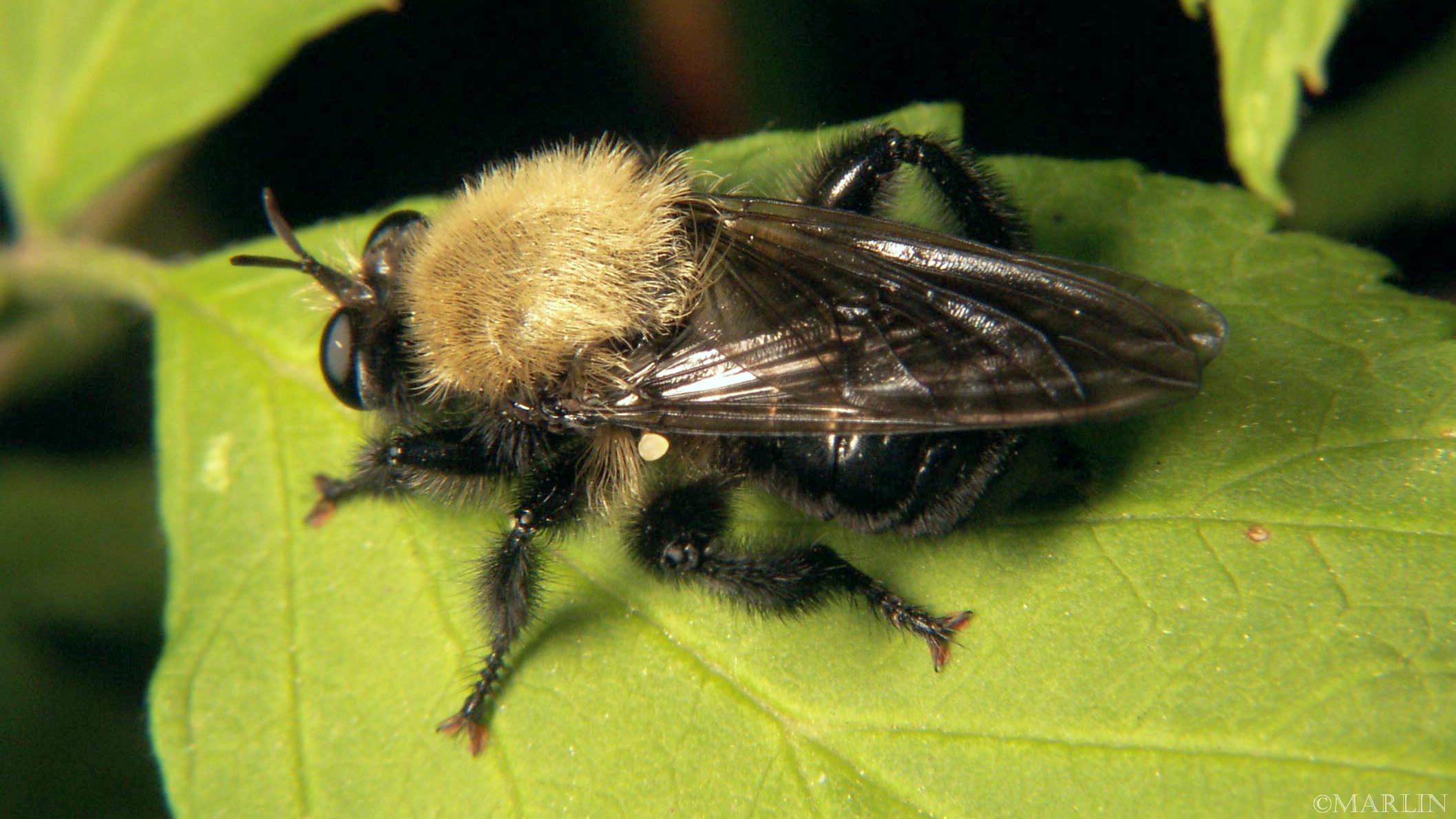
Robber Fly - Laphria flavicollis
Diptera Family Asilidae - Robber Flies
This female measures 18mm from antennae to tip of wings.
Cirrus Home | Flies Table of Contents | Flies Main Page Graphics | Family Tachinidae | Family Syrphidae | Bombyliidae
 

Robber Fly - Laphria flavicollis

The Asilidae genus Laphria contains some very convincing bumblebee mimics. As true flies, these robbers only have one set of flying wings. The second set present in all other insects, has evolved in the flies into small ball-like organs called halteres (visible as the whitish ball just under the base of the wing). Their function has not been fully explained, but it is thought they provide kinesthetic (balance and body postion) information during flight.

There are over 7,000 species of robber flies world wide; nearly 1,000 in North America.  All robber flies have stout, spiny legs, a dense moustache of bristles on the face (mystax), and 3 simple eyes (ocelli) in a characteristic depression between their two large compound eyes. The mystax helps protect the head and face when the fly encounters prey bent on defense. The antennae are short, 3-segmented, sometimes with a bristle-like structure called an arista. The short, strong proboscis is used to stab and inject victims with saliva containing neurotoxic and proteolytic enzymes which paralyze and digest the insides; the fly then sucks the liquefied meal much like we vacuum up an ice cream soda through a straw. Many species have long, tapering abdomens, sometimes with a sword-like ovipositor. Others are fat-bodied bumble bee mimics; the effect is quite convincing. Take a close look at any insect that looks like a bumble bee if it's sitting on a leaf - chances are, it's a robber fly. (Bumble bees as a rule do not sit in one spot for more than a few seconds).

Robber Fly
Laphria grossa


Custom Search

Cirrus Home | Flies Table of Contents | Flies Main Page Graphics | Family Tachinidae | Family Syrphidae | Bombyliidae


© Red Planet Inc.