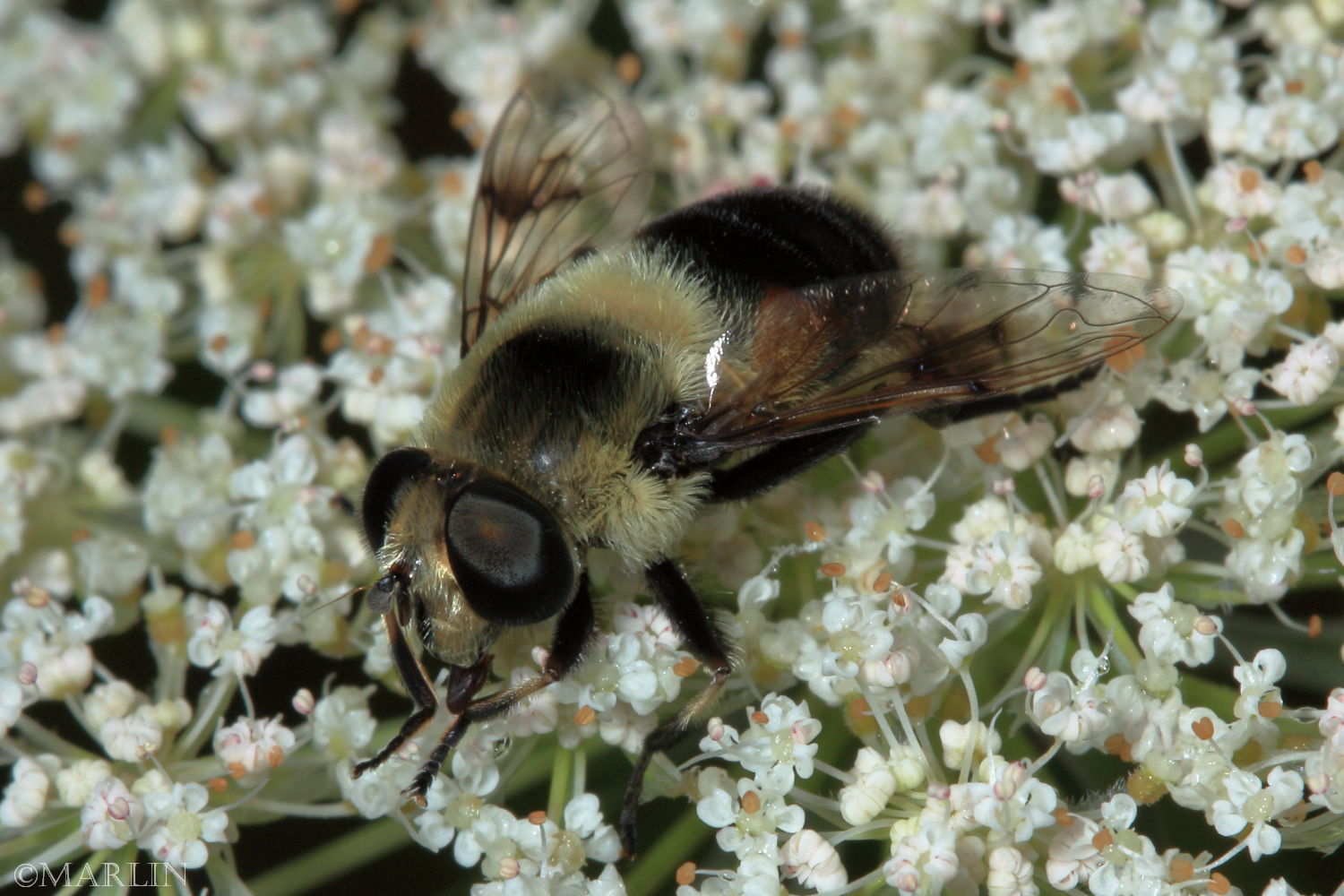
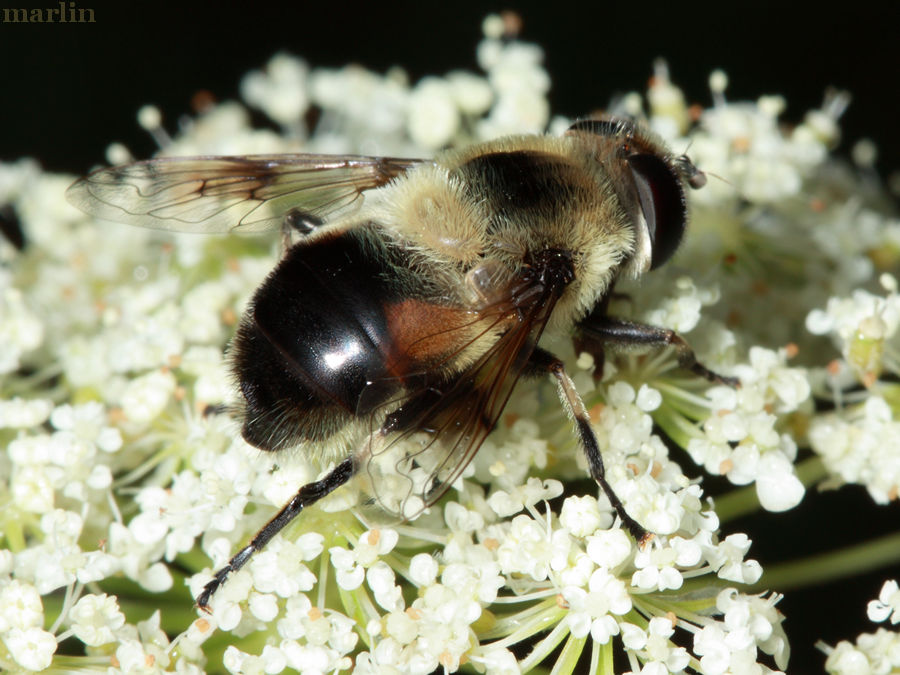
Syrphid Fly - Eristalis anthophorina [2]
Diptera Family Syrphidae
Live adult Syrphid fly photographed in the wild at Marienville, Pennsylvania, USA.
[Cirrus Home]   [Flies Main Page Graphics]   [Flies Table of Contents]  [Family Syrphidae]  [Family Tachinidae]
  Syrphid Fly - Eristalis anthophorina

The hover flies are a large group of superbly beneficial insects. Their coloring and movements of most species mimic bees or wasps -- they are either stout-bodied and covered with hair, resembling a bumble bee, or boldly patterned with yellow, orange and black, resembling aculeate (stinging) wasps. Some species even go so far as to wave their front legs in front of their face to mimic the jointed antennae of aculeate wasps. This phenomenon is called Batesian mimicry, indicating that defenseless organisms resemble or "mimic" dangerous or unpalatable models.

Adult hover flies require nectar or honeydew and pollen to ensure their reproduction (as well as to power their physical activities), and larvae generally require aphids for breakfast, lunch and dinner to complete their development. However, in the absence of aphids, larvae of some species can subsist and develop entirely on diets of pollen [1].

Syrphid Fly - Eristalis anthophorina

Quite a few flower fly species feed on aphids (aphidophagous). All are in the subfamily Syrphinae. Common aphidophagous flower flies in California vegetable crops include Toxomerus marginatus, Allograpta obliqua, Syrphus opinator among many others.

Syrphid flies are routinely used as a biological control in the lettuce fields of California's vegetable-producing regions, where the fly's larvae are generally effective in controlling lettuce aphid (Nasonovia ribisnigri). It is primarily the Syrphidae that enable organic romaine growers on California's central coast to produce harvestable crops.

Syrphidae larvae are, in turn, parasitized by wasps in the Hymenoptera families Ichneumonidae and Pteromalidae [1].

Syrphid Fly - Eristalis anthophorina
This female Syrphid fly is superb bumble bee mimic.

[Cirrus Home]   [Flies Main Page Graphics]   [Flies Table of Contents]  [Family Syrphidae]  [Family Tachinidae]

References
  1. University of California, DANR, "Flower Flies (Syrphidae) and Other Biological Control Agents for Aphids in Vegetable Crops" .pdf
  2. BugGuide.net, Eristalis anthophorina
              
 
       web      www.cirrusimage.com