|
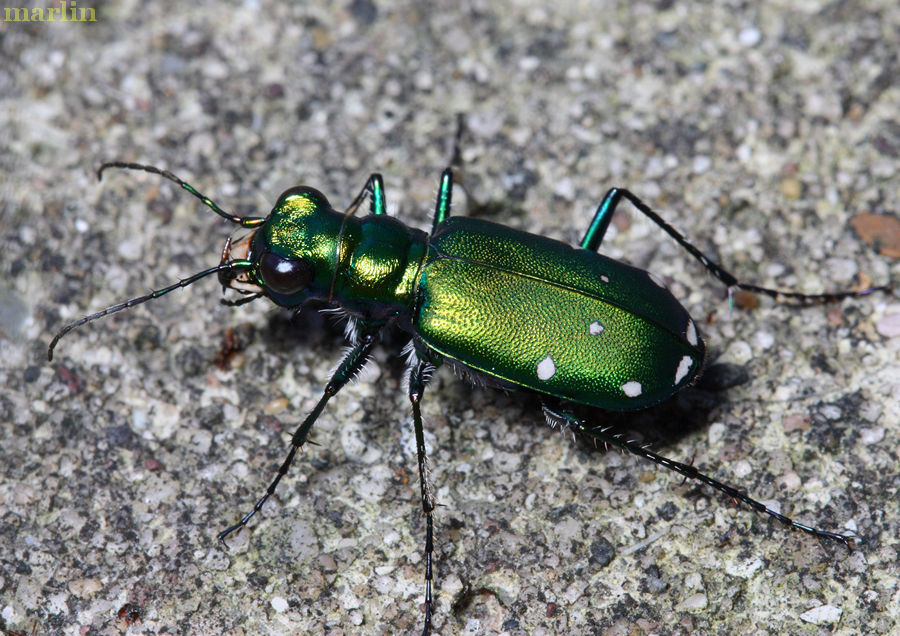
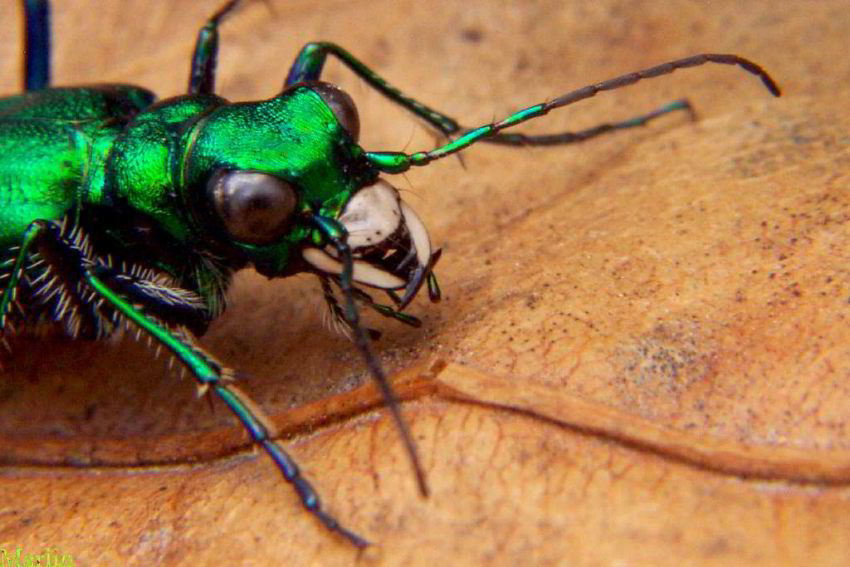
The tiger beetles (family Cicindelidae) are members
of the suborder Adephaga within the Order Coleoptera. Adult tiger
beetles are characterized by large, prominent compound eyes and
eleven-segmented, filiform antennae. The antennae are inserted on the
frons above the clypeus and below the eyes. The head, at the eyes, is
wider than the pronotum (in most common genera of cicindelids). The
tarsi are five-segmented.
Adult beetles of the families Cicindelidae (tiger beetles) and Carabidae
(ground beetles) are quite similar morphologically, and some
entomologists place the tiger beetles in the subfamily Cicindelinae
within the family Carabidae. The ground beetles differ in the following
ways: antennae inserted above the mandibles to the side of the clypeus,
and below the eyes. Most ground beetles have a head, at the eye, which
is narrower than the pronotum. Cicindela dorsalis was
named by Thomas Say in 1817 and Cicindela
media by John LeConte in 1857; currently,
these two are considered subspecies of the same
species. C. dorsalis media occurs long the
southeast coast of the United States, including
South Carolina and C. dorsalis dorsalis occurs
along the northeast coast. Two other subspecies,
C. dorsalis saulcyi and C. dorsalis venusta, are
found along the coasts of Florida, the Gulf of
Mexico and Mexico (Boyd 1982).
The white beach tiger beetle ranges from 10.5 to
13.5 mm (0.41 to 0.53 inches) in length. Like
all tiger beetles, its legs and antennae are
long and slender and its jaws are large. The
elytra (wing coverings) are white with narrow
sinuous bronze markings; the head and pronotum
are bronze. The pronotum and sides of the under
surface are densely covered with white hairs.
The sides of the elytra of males are nearly
parallel whereas females are somewhat more
broadly rounded. The pale coloration renders the
beetle well camouflaged on the light sand where
it lives.
Status
The northern white beach tiger beetle, C. dorsalis
dorsalis, is on the federally threatened list because of
extensive destruction of its habitat. This subspecies
historically ranged from Massachusetts to the Chesapeake
Bay and is now found only in the Chesapeake Bay area.
Even there, the narrow beaches, 3 to 10 meters (9.8 to
32.8 feet) in width, are barely wide enough to support
this beetle. The related subspecies in South Carolina,
the southern white beach tiger beetle (C. dorsalis
media), is being extirpated in parts of its range as
well; however, there is no federal or state ranking for
this species.
POPULATION DISTRIBUTION AND SIZE
This beetle historically ranged from southern New Jersey
to Miami, but its range has been diminished at both
extremes. In South Carolina, it once occurred on all
wide sandy beaches, but no longer is present where human
development or severe erosion have destroyed appropriate
habitat, such as in the city of Myrtle Beach (Knisley
and Schultz 1997). It still may be found on Cicindela
dorsalis media
those beaches that are relatively undisturbed, including
Waites Island, Cherry Grove Beach, Huntington Beach,
Isle of Palms, Folly Island, Seabrook Island and Edisto
Beach; the largest population is at Seabrook Island
where the dunes are most extensive. It occurred on
Hunting Island as recently as 2002 but the beach has
undergone severe erosion so its current status is in
doubt.
Population size for the white beach tiger beetle has not
been determined in South Carolina.
HABITAT AND NATURAL COMMUNITY REQUIREMENTS
The adult white beach tiger beetle is a predator; the
adults run actively on the sand to catch prey that
includes small insects. Larvae are also predators,
hiding in burrows with only their jaws protruding to
catch unwary insects or a variety of small animals of
suitable size that come within their reach. Therefore,
larvae need a safe place for development above the high
tide line; both stages require a large enough expanse of
naturally shifting ocean beach so that sufficient prey
is available.
CHALLENGES
Loss of habitat represents the most significant
challenge to South Carolina’s white beach tiger beetle.
Building and road construction, deposition of dredge
spoil, extensive driving on the beach and heavy foot
traffic can destroy the natural qualities of a beach so
as to make it uninhabitable by beach tiger beetles.
Erosion can narrow or eliminate the sandy beach and
severely impact the beetles. Construction of groins and
bulkheads reduces natural movement of the sand and
suitability for these tiger beetles (Knisley and Schultz
1997). Water quality offshore needs to be moderately
clean and free from toxic substances (such as oil
spills) so that aquatic and semi-aquatic animals are
available as prey for tiger beetles and so that larvae
are not poisoned in their burrows (Knisley and Schultz
1997).
CONSERVATION ACCOMPLISHMENTS
Efforts to save the endangered least terns on our public
beaches also contribute to an environment suitable for
tiger beetles. This effort is largely fencing off tern
nesting areas and informing the public about the
necessity to protect the terns. Actions to protect the
dunes themselves, such as keeping people off the dunes,
preventing sea oats collection and prohibiting
structures such as groins and bulkheads all contribute
to a good habitat for these beetles.
CONSERVATION RECOMMENDATIONS
-
Conduct surveys for the white
beach tiger beetle to track its continued decline
and/or return to available habitat.
-
Work with appropriate state, local and non-governmental
agencies and coastal municipalities and communities to
reduce current and future impacts of development on
beach environments.
-
Educate the public about the importance of beach dune
habitat and initiate participative projects such as dune
vegetation plantings.
-
Encourage planned development projects in coastal zones,
particularly on barrier islands to reduce associated
impacts of development on the long-term health of sandy
beach habitats in South Carolina.
-
Discourage building or repair of seas walls and groins
on South Carolina’s beaches to allow more natural
movement of sand and, ultimately, more natural beach
renourishment.
-
When feasible, remove dams and reservoirs that block
flow of sand and sediment from upland areas to allow for
more natural beach renourishment.
[1]
|